
5-Axis Workholding Systems: Practical Solutions That Actually Hold
5-Axis Workholding Systems: Practical Solutions That Actually Hold
5-axis machining promises one-setup accuracy — machine five faces of a part without touching it by hand. The catch is that “one setup” lives or dies on workholding. A part that lifts, rotates, or shifts during the B/C move turns a precision cycle into scrap. This guide covers workholding that actually holds through 5-axis motion, and how to combine zero-point, self-centering, and dual-station clamping into a cell that runs.
If you are still deciding between vise types, our self-centering vs traditional vise comparison is the place to start. For the system behind the vise, see the zero-point clamping system guide.
Why 5-axis workholding is harder than 3-axis
Choosing among 5 axis workholding systems starts with the motion the fixture must survive. In three-axis machining, the setup is often planned around a more limited range of tool directions. With five-axis machining, the workpiece and fixture may rotate while the tool approaches from changing angles. A setup that looks clear from the front can become a collision risk after the rotary table tilts.
Workholding therefore has to balance three requirements: keep the part rigid, leave enough space for the tool and holder, and establish a reliable datum. These requirements can conflict. Raising a part may improve access to its underside but increase leverage and vibration; using larger clamps may improve grip but block the cutter. The best solution is usually the lowest, simplest fixture that safely supports the actual cutting strategy.
On a 3-axis machine the part mostly sees down-force and side-force in predictable directions. On a 5-axis table the part rotates through the tool envelope, so cutting forces can come from any angle — including “up” when the table flips past vertical. Workholding has to resist all of them while staying clear of the tool path on every rotary position.
Three failure modes show up most:
- Interference — the vise or clamp swings into the spindle at some B/C angle.
- Lift — the part rocks because clamping force is mostly vertical and the cut pushes sideways.
- Datum loss — re-fixturing between rotary setups drifts the coordinate system.
Good 5-axis workholding is engineered around all three at once.
Start with a low-profile base
The single biggest lever is how much you raise the part off the table. Every millimeter of stack-up is a millimeter the tool can crash into and a millimeter of lost rigidity. A low-profile zero-point base or a dedicated 5-axis sub-plate keeps the part close to the rotary axis.
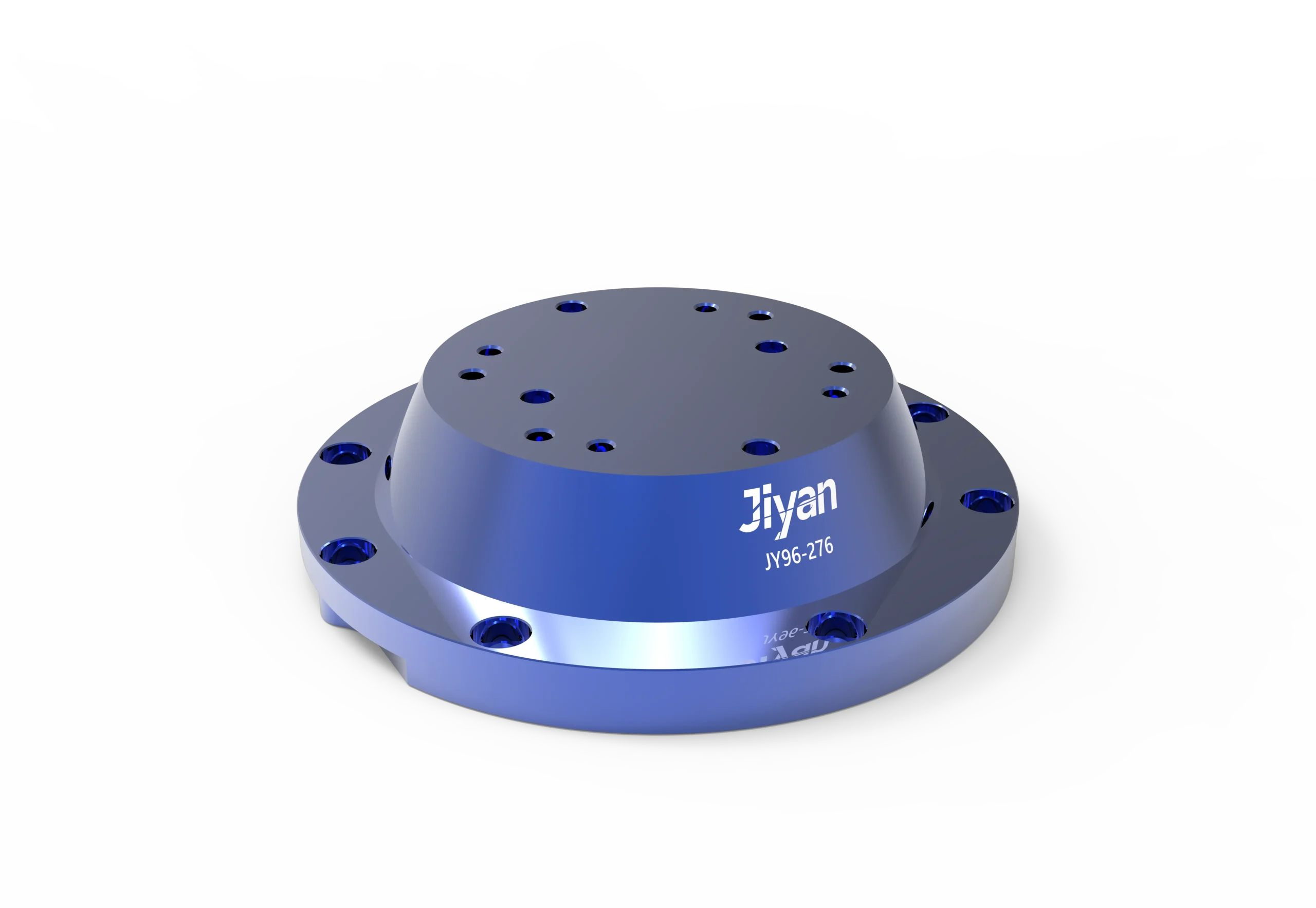
A low-profile zero-point base keeps the part near the rotary axis — less interference, more rigidity through the B/C move.
This is where a zero-point clamping system earns its place: instead of a tall custom tombstone, you mount a thin base and drop pallets or vises onto it, staying low and repeatable.
Self-centering vises for round and irregular stock
A lot of 5-axis work starts from castings, forgings, or round bar — stock with no flat reference. A self-centering vise grabs the part from both sides at once and pulls it to a known centerline, so you do not spend setup time indicating an irregular surface.
For a shop comparing 5-axis CNC workholding options, a self-centering design is especially useful when similar parts are produced repeatedly or when the stock geometry makes manual alignment time-consuming. It can simplify the setup process, but it is not automatically the right choice for every component. Confirm that the jaws contact a suitable area, the part cannot rock, and the available clamping range covers the stock dimensions.
Before machining, check the jaw opening, clamping height, contact surfaces, and clearance at the most demanding rotary angle. Thin walls and finished surfaces may need softer or custom jaws to avoid distortion or marking.
Why it matters in 5-axis specifically:
- The part center is known before the first cut, so your CAM zero lines up with the vise center.
- One vise handles a range of diameters instead of a dedicated jaw set per size.
- Combined with a zero-point sub-plate, the vise itself becomes swappable between machines.
For the trade-offs versus a traditional vise, the self-centering comparison lays out the numbers.
The 6-station cube: one load, six faces
When the part is small and the batch is real, a 6-station zero-point cube is the highest-density option on a 5-axis table. Six faces, each with its own zero-point base, each carrying a part or a sub-plate. One pallet load gives you a full envelope of work.
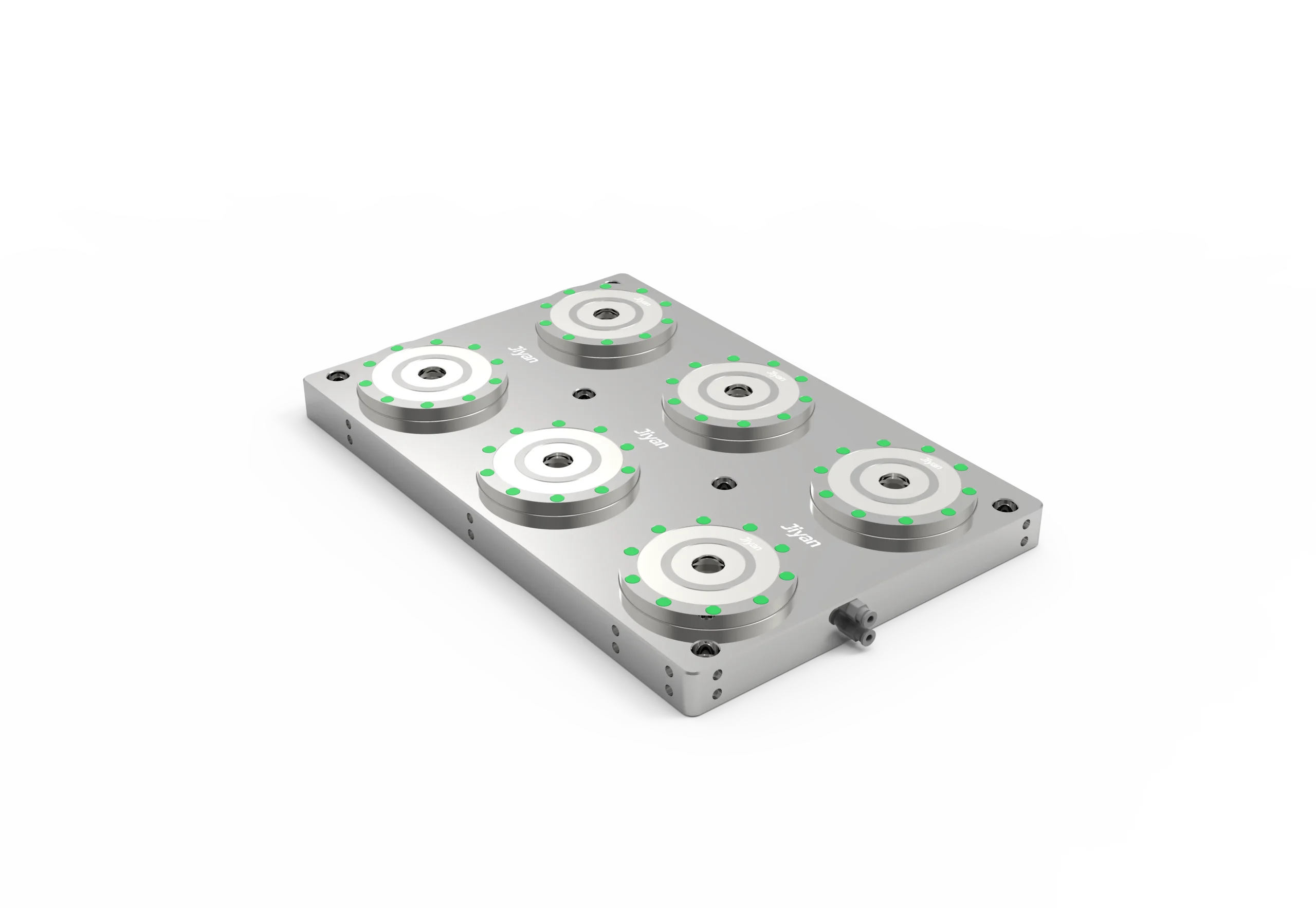
The H138-6C six-station zero-point cube — six located faces from a single table load.
The cube turns a 5-axis table into a mini production cell: load six parts offline, clamp the cube, run all faces, unload, repeat. Changeover is “swap the cube,” not “re-fixture six parts.” This is the pattern behind most successful unattended 5-axis running.
Combining zero-point + vise + pallet
These components are most useful when they work as one coordinated system. A zero-point interface establishes the fixture location, a vise or sub-plate holds the part, and a pallet or multi-station fixture lets operators prepare the next batch away from the machine. This modular approach is one of the practical 5 axis workholding solutions for shops running a mix of parts.
Before combining components, verify the locating pitch, stud geometry, mounting pattern, fastener specification, and load limits. Similar product names do not guarantee compatibility across manufacturers. Keep locating surfaces clean and inspect the interface for chips or damage; contamination between mating surfaces can affect seating and repeatability.
The strongest 5-axis cells stack three layers:
- Zero-point base on the rotary table (low, repeatable datum).
- Self-centering vise or sub-plate dropped onto the base (part centers itself, fixture locates itself).
- Pallet carrying multiple bases for batch runs.
Each layer removes a manual step. The operator loads parts at the bench, not at the machine. The machine runs the envelope; the bench builds the next load. Throughput is set by cycle time, not by how fast someone can indicate a vise.
Avoiding interference: the path-clearance checklist
Before you trust a setup, run this on the bench:
- Spin the table empty. Rotate through the full B/C range with the vise mounted and no part. Watch for any swing into the spindle or door.
- Model the envelope. In CAM, simulate the holder against the fixture at every rotary position, not just the start.
- Keep clamps inside the part footprint. Extenders and straps that stick out are the first things to crash.
- Lower the stack. If the simulation shows near-misses, drop to a thinner base or shorter jaws before you slow the feed.
Interference is cheaper to fix in CAM than on the floor.
Holding force where the cut actually is
Clamping force should be evaluated against the actual operation, not selected from a headline number alone. Roughing, interrupted cuts, long tools, and tall workpieces can create different loads and leverage. Review the manufacturer’s clamping and load data, then consider how the force travels through the part, jaws, fixture body, locating interface, fasteners, and machine table. A strong clamp cannot compensate for a flexible fixture stack or poor contact with the workpiece.
Where practical, keep the workpiece close to the support and avoid unnecessary risers. Confirm that the clamping method is suitable for the material and finished surfaces, and that chips cannot prevent the part from seating. For unattended machining, use the machine’s and fixture system’s prescribed checks to verify engagement before starting the cutting cycle. Never rely on an assumed clamp state when the application requires confirmation.
5-axis roughing puts force on the part from awkward angles. Two rules keep it put:
- Clamp across the cut, not just under it. Side-located clamps resist the rotational force better than down-force alone.
- Match force to the heaviest cut. A base sized for finishing will chatter in roughing. Spec for the worst case.
A properly specified zero-point base holds aggressive roughing because the clamp pulls the stud onto a fixed reference face with kilonewtons of force — the part cannot lift off the datum.
When to use a dedicated fixture instead
Zero-point and vise systems offer flexibility, but modularity is not always the most efficient answer. For a high-volume component that runs continuously, a dedicated fixture may provide better part density, faster loading, or more direct support at critical cutting locations. A modular setup can be preferable when the shop frequently changes jobs, needs to prepare fixtures offline, or wants to share tooling across compatible machines.
Use a simple comparison before committing to a design:
| Workholding option | Best fit | Check before selecting |
|---|---|---|
| 5-axis vise | Flexible machining of prismatic parts | Jaw range, clamping force, tool clearance |
| Zero-point plate | Frequent fixture changes and repeatable location | Interface compatibility, cleanliness, load rating |
| Multi-station cube or pyramid | Batch work and several fixture faces | Rotary clearance, assembly mass, spindle access |
| Dedicated fixture | Stable, high-volume production of one part family | Engineering cost, part support, changeover needs |
This comparison is a starting point, not a substitute for simulation or manufacturer specifications. Evaluate the complete setup, including the workpiece, jaws, fixture, fasteners, tool holder, and rotary table.
Zero-point and vises are flexible, but for a high-volume single part a dedicated 5-axis fixture still wins on density and speed. Use modular workholding when:
- The mix is high and batches are short.
- You want one fixture to serve several machines.
- Setup time, not cycle time, is the bottleneck.
Use a dedicated fixture when the same part runs all week and every second of cycle time matters. Most shops need both — modular for the long tail of jobs, dedicated for the heroes.
Pair these solutions with the 5-axis workholding guide for a complete fixture strategy.
How to select a 5-axis workholding system
Use a repeatable review process instead of choosing a fixture by appearance alone. First, list the surfaces and features that must be machined, then identify suitable clamping areas and any thin or delicate sections. Next, simulate the complete tool and holder through the intended B/C movement. Confirm that the fixture remains clear and that the part is supported close to the cutting forces wherever possible.
Then compare the production requirements. For one-off work, flexibility may matter most. For recurring batches, repeatable locating and offline preparation can save setup effort. For multi-part production, a cube or pyramid may increase machine utilization, provided all positions are accessible and the total assembly stays within the machine’s load limits. Finally, check the supplier’s specifications and document the clamping and inspection procedure so the setup can be repeated safely.
FAQ
Can I run 5-axis unattended with these? Yes, with sensor-confirmed zero-point clamping and a cube or pallet. The machine verifies engagement before each cycle.
Do I need a self-centering vise? Only if your stock lacks a flat reference. For square bar, a standard vise on a zero-point sub-plate is enough.
What is the biggest mistake? Tall, custom tombstones that interfere and flex. Stay low and standard.
Conclusion
5-axis workholding is an exercise in staying low, staying located, and removing the operator from the loop. Anchor on a low-profile zero-point base, center parts with a self-centering vise, and batch with a 6-station cube or pallet — and the “one setup” promise actually holds.
Want help matching a base, vise, and cube to your 5-axis table? Contact JIYAN and we will spec the cell.