
5-Axis Workholding: How to Hold Parts So Your 5th Axis Actually Pays Off
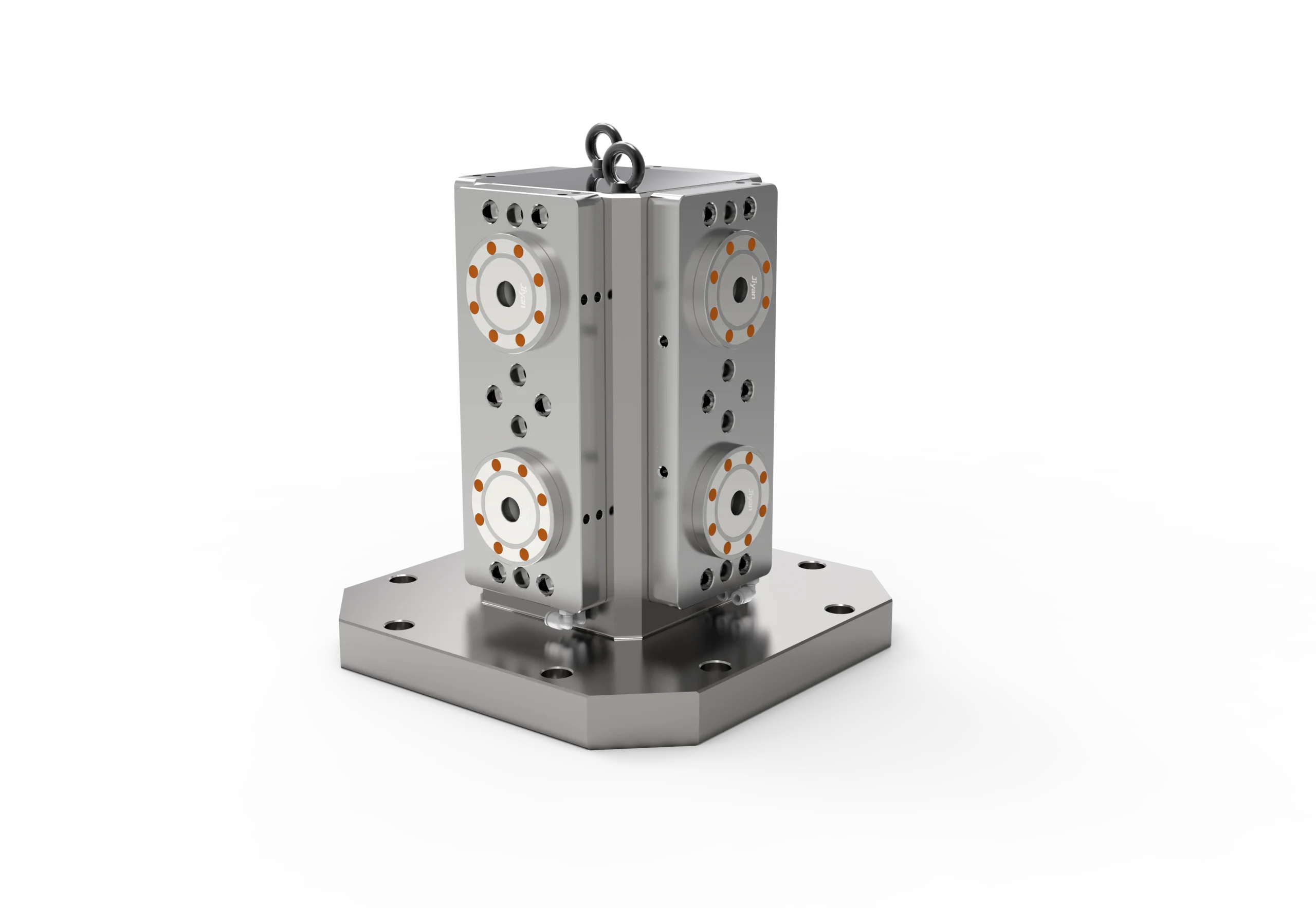
5-axis workholding is the system of vises, tombstones, zero-point bases, and fixtures you use to hold a part so a 5-axis machine can reach five faces in one setup. On a 3-axis mill, workholding mostly means "grab it in a vise and indicate it." On a 5-axis machine, the part has to stay located while the table tilts and rotates under it — so 5-axis workholding is less about gripping force and more about access, repeatability, and how little of the envelope your fixture eats. Get it right and your 5th axis pays for itself in spindle time. Get it wrong and you own an expensive 3-axis machine that happens to tilt.
If you have ever watched a 5-axis job spend more time on fixture change and re-indicating than on actual cutting, this guide is for you. We will walk through what 5-axis workholding really demands, the seven strategies that work on the floor, why a 5 axis tombstone vise is the highest-density option most shops overlook, and the mistakes that quietly kill throughput.
Why a 5-axis machine is only as good as its workholding
A 5-axis machine earns its premium by cutting more faces per setup. Every extra setup you avoid is time saved and accuracy gained — no re-clamping error, no second operation tolerance stack-up. But that whole advantage collapses the moment your fixture blocks the tool path or forces a manual re-zero.
Three things make 5-axis workholding different from 3-axis:
- Clearance is the constraint, not clamp force. The tool swings around the part. A bulky vise or tall jaw can shadow a face you needed to machine, forcing a second op anyway.
- The part must stay located through rotation. Indicating once and hoping is not enough — the A/B axes move the part relative to the spindle, so your datums have to be rock-solid and repeatable.
- Setup change is where the money leaks. If swapping a tombstone or vise takes 20 minutes of indicating, you have rebuilt a 3-axis workflow on a 5-axis budget.
That is the core idea: 5-axis workholding is a throughput problem disguised as a clamping problem. The shops that win are the ones who make the fixture change as fast and repeatable as the cut.
The 7 workholding strategies that actually work on 5-axis
You do not need all seven on day one. Most shops adopt them in order, and each one removes a chunk of dead time.
1. Put a tombstone on the table — and a zero-point base on it
A tombstone (a vertical fixture block, often called a four-sided tower) lets you load parts on multiple faces at once. Mount a 5 axis tombstone vise arrangement or a bank of zero-point bases on each face, and you can run a whole batch of different parts in one tilt cycle.
The repeatability trick is a zero point clamping system. Instead of indicating the tombstone every time it goes back on the table, you seat it on a zero-point base and it returns to the same location within ±0.005 mm. Our full write-up on how a zero point clamping system works and the setup-time savings it delivers covers the mechanics — on 5-axis especially, it is the difference between "swap and cut" and "swap and re-indicate for 15 minutes."
2. Mount self-centering vises on the tombstone
Self-centering vises pull the part to a fixed centerline, so you do not indicate each blank. On a tombstone that means you can pre-load several vises offline and the machine just cuts. They also sit low and compact, which helps clearance in the A-axis swing.
If you are weighing self-centering against a standard screw vise, the trade-off is documented in our self-centering vs traditional CNC vise comparison — on 5-axis the centering advantage matters more because you are loading blind into a rotating envelope, not staring at the jaw.
3. Use modular fixture risers to reach the envelope
Tall parts need to clear the table and the opposing tombstone face. Modular risers and sub-plates let you lift the part into the sweet spot of the rotary envelope without building a custom fixture every time. Keep a small kit of standard heights and you can compose most setups from inventory.
4. Soft jaws and custom fixtures for odd shapes
Castings, forgings, and bent brackets do not sit in a standard jaw. Machine a set of soft jaws (or a dedicated fixture) to the part's actual shape and you get three wins: better grip, no marking, and a known datum the moment the part drops in. For low-volume but high-value 5-axis work, one good soft-jaw fixture often pays for itself in reclaimed setup time.
5. Direct-to-table zero-point plates for big parts
Not everything fits a tombstone. Large plates and housings often belong straight on the table. A grid of zero-point plates turns the table into a reusable, repeatable datum: drop the part (or its sub-fixture) on, lock, cut. No indicating, no toe-clamp roulette. This is also the move when you want to mill one big face and then tilt for the sides without losing your origin.
6. Match clamp force: hydraulic vs pneumatic
Hydraulic gives high, uniform force for heavy roughing. Pneumatic is faster and cleaner for lighter finishing and high-mix work. On 5-axis you usually want the force where the cut is heaviest and the speed where the change is frequent. A pneumatic dual-station vise is a practical option when you are finishing small parts and want to load one station while the other cuts.
7. Pendulum machining: cut on one side, load on the other
The highest-leverage 5-axis pattern is pendulum work — fixtures on both sides of the tombstone, machine one while you load the other. The spindle never waits for the operator. It only works if your workholding is fast and repeatable (strategies 1–2), but when it does, your spindle uptime jumps and your "5-axis" finally behaves like one.
If any of this sounds like it is really about changeover speed, you are right — the same principles show up in our guide to reducing CNC setup time with seven proven strategies. 5-axis just raises the stakes because the machine is more expensive to leave idle.
The 5 axis tombstone vise: the high-density option
A 5 axis tombstone vise is the configuration most small and mid-size shops under-use. Instead of one part in one vise, you get a vertical block carrying four (or more) faces of work, each face holding one or several self-centering vises or zero-point bases.
Why it earns a spot:
- Density. Four faces × multiple parts per face = a tombstone full of work in a single tilt cycle. You are cutting while a 3-axis cell would still be on its second part.
- Repeatability. Seat the tombstone on a zero-point base and every reload is identical. No indicating the block, no hunting the origin.
- Clearance-friendly. Modern tombstone vises are built low and back-cut so the tool can swing past. That is exactly what 5-axis needs and what a random bulky vise fights.
- Mixed batches. Different parts on different faces run in one program sequence — ideal for the high-mix, low-volume work 5-axis is bought for.
JIYAN builds four-sided towers and the matching zero-point bases in-house at our Dongguan Chang'an plant — machining, heat treatment, grinding, and inspection all under one roof — so the reference faces hold their repeatability instead of drifting after a few hundred cycles. That in-house control is what lets a tombstone stay a datum and not become a wear part.
A 5-axis mini story
A job shop we work with ran a family of 12 aluminum brackets on a brand-new 5-axis mill. For the first month the numbers looked wrong: the machine cost twice their old 3-axis cell but shipped about the same parts per day. The reason was on the floor, not in the spindle.
Every bracket was loaded one at a time in a standard vise, indicated by hand, and the tombstone was re-zeroed whenever it came off the table for a different job. The 5th axis was real, but the workflow was 3-axis.
They changed three things from this list: moved repeat parts onto self-centering vises on a four-sided tower, seated the tower on a zero-point base, and started staging the next tower while the first one cut (pendulum). Within six weeks, parts-per-day on that machine roughly doubled — same spindle, same programmer, no new fixture inventory beyond the tower and bases. The owner's line: "The machine was never the bottleneck. The fixture change was."
That is the whole point of 5-axis workholding: the axis count is only an advantage if your holding lets the machine use it.
5-axis vs 3-axis: what actually changes in the fixture room
The part does not care how many axes the machine has. The fixture room does. Here is the honest comparison shops live with once a 5-axis machine lands:
| Factor | 3-axis workholding | 5-axis workholding |
|---|---|---|
| Setups per part | 2–4 (flip for each face) | 1 (all faces in one go) |
| How you locate | Indicate the vise, cut | Seat on zero-point base, cut |
| Biggest time leak | Re-fixturing between ops | Fixture change + reload |
| Clearance concern | Jaw height vs Z | Full A/B swing around the part |
| Best fixture | Standard vise | Tombstone + zero-point + self-centering |
| Spindle idle cause | Waiting on the next op | Waiting on the operator to load |
The takeaway is not "5-axis is better" — it is. The takeaway is that 5-axis workholding moves the bottleneck from cutting to loading. Solve loading (zero-point bases, offline vises, pendulum) and the machine finally runs like the invoice says it should.
Material matters: aluminum vs steel on 5-axis
The same tombstone strategy behaves differently by material, and the fixture is where it shows:
- Aluminum: light and tendency to distort under clamp load. Use moderate pneumatic force and wider soft jaws so you do not pinch the part out of flat. Aluminum also machines fast, so your loading speed — not your spindle — becomes the limiter sooner. This is exactly why small-shop workholding for aluminum-heavy work and 5-axis planning overlap.
- Steel / stainless: heavier cuts need hydraulic force, but the parts are often fewer and larger. A direct-to-table zero-point plate plus a low-profile vise keeps the envelope clear while you rough hard.
- Titanium / exotics: rigidity wins. Minimize overhang, maximize contact area with custom soft jaws, and keep the tombstone seated on a zero-point base so the heavy roughing never knocks your datum loose.
Match the holding to the material and the axis count stops being a liability on hard parts.
Common 5-axis workholding mistakes
- Bulky vises that shadow the tool path. If your fixture blocks a face, you just rebuilt a second operation. Go low and compact.
- Indicating the tombstone every reload. That is the single biggest time leak. A zero-point base removes it.
- Clamping force mismatch. Over-clamping thin parts distorts them; under-clamping lets them move mid-cut. Match hydraulic/pneumatic to the op.
- No offline loading. If the operator loads only when the spindle stops, you are not doing pendulum work — you are paying pendulum prices.
- Forgetting the envelope. Tall jaws or risers that push the part outside the rotary envelope cause crashes or missed faces. Mock it up before you cut.
These are the same failure modes we see on 3-axis cells, just amplified — which is why our small-shop workholding guide and this one overlap more than people expect. The fundamentals travel; the envelope just gets tighter.
Build your 5-axis workholding kit
A practical starter kit, in the order most shops adopt it:
- One four-sided tower (four-sided fixture block) sized to your table.
- Two or three zero-point bases — one for the table, one for the tower, one spare.
- A pair of self-centering vises for repeat blanks.
- A set of soft jaws for your top-value odd-shape part.
- One direct-to-table zero-point plate for large plates.
JIYAN supplies the towers, zero-point bases, self-centering vises, and the pneumatic options from one plant, so the interfaces actually match — the base, the stud, and the vise reference faces are made to the same datum. That matters more on 5-axis than anywhere else, because the whole point is locating the part the same way every time it rotates.
Browse the zero-point product line to compare plates and bases, or see how the complete CNC vise family fits a 5-axis cell.
JIYAN 5-Axis Workholding Products
Every fixture below is machined in-house from solid steel or aluminum and stays rigid through full five-axis motion.
| Strategy | When it wins | JIYAN option |
|---|---|---|
| Zero-point pallet / cube | High-mix batches, fast changeover | H138 twin-cube clamp, 6-station pallet |
| Tombstone-style cube | Four or more faces per cycle | H138 4-station cube |
| Rotary / indexing | Full 4th- and 5th-axis machining | 4th-axis rotary zero-point module |
| Synchronized clamping | Small to medium prismatic parts | JY77 self-centering vise |
Describe your machine table and cycle mix, and request a quote for a 5-axis workholding cell.
FAQ
What is 5-axis workholding?
5-axis workholding is the combination of vises, tombstones, zero-point bases, and fixtures used to hold a part so a 5-axis machine can machine multiple faces in one setup. The goal is access, repeatability, and fast fixture changes — not just clamping force.
What is a 5 axis tombstone vise?
It is a vertical fixture block (tombstone) carrying vises or zero-point bases on multiple faces, so several parts can be cut in one tilt cycle. It is the highest-density 5-axis workholding option for high-mix work.
Do I need zero-point clamping for 5-axis?
Not strictly, but it removes the single biggest time leak — re-indicating the tombstone or part on every reload. A zero-point base returns the fixture to the same location within ±0.005 mm, which is what makes pendulum machining practical.
Hydraulic or pneumatic clamping on 5-axis?
Use hydraulic for heavy roughing where force matters; use pneumatic for lighter finishing and fast, clean changes on high-mix work. Many cells run both, matched to the operation.
How do I raise spindle uptime on a 5-axis machine?
Adopt pendulum machining (load one side while the other cuts), seat fixtures on zero-point bases for repeatable reloads, and load vises offline. The machine should rarely wait for the operator.
Get your 5th axis working
The axis count is only an advantage if your workholding lets the machine use it. A four-sided tower, a couple of zero-point bases, and self-centering vises will take most shops further than any new gadget.
Talk to JIYAN workholding engineers about a 5-axis setup sized to your table and parts, or browse the zero-point product line to compare towers, plates, and studs.
Fixturing more in fewer setups starts with one tower. Get a quote →
Related guide: Pneumatic Dual-Station Vise: How a 2-Station CNC Vise Doubles Your Spindle Time
Related: CNC Automation Warehouse — 5-Axis Automated Loading and Unloading — recommended reading before specifying 5-axis automated loading and unloading.