
Self-Centering Vise vs Traditional CNC Vise: How to Choose the Right Workholding
Most shops own a drawer of traditional CNC vises long before they ever touch a self-centering unit. Then a batch of symmetrical parts shows up, setup time balloons, and suddenly the "obvious" vise is the bottleneck. This guide breaks down how the two designs actually work, where each one earns its keep, and how to choose without guessing.
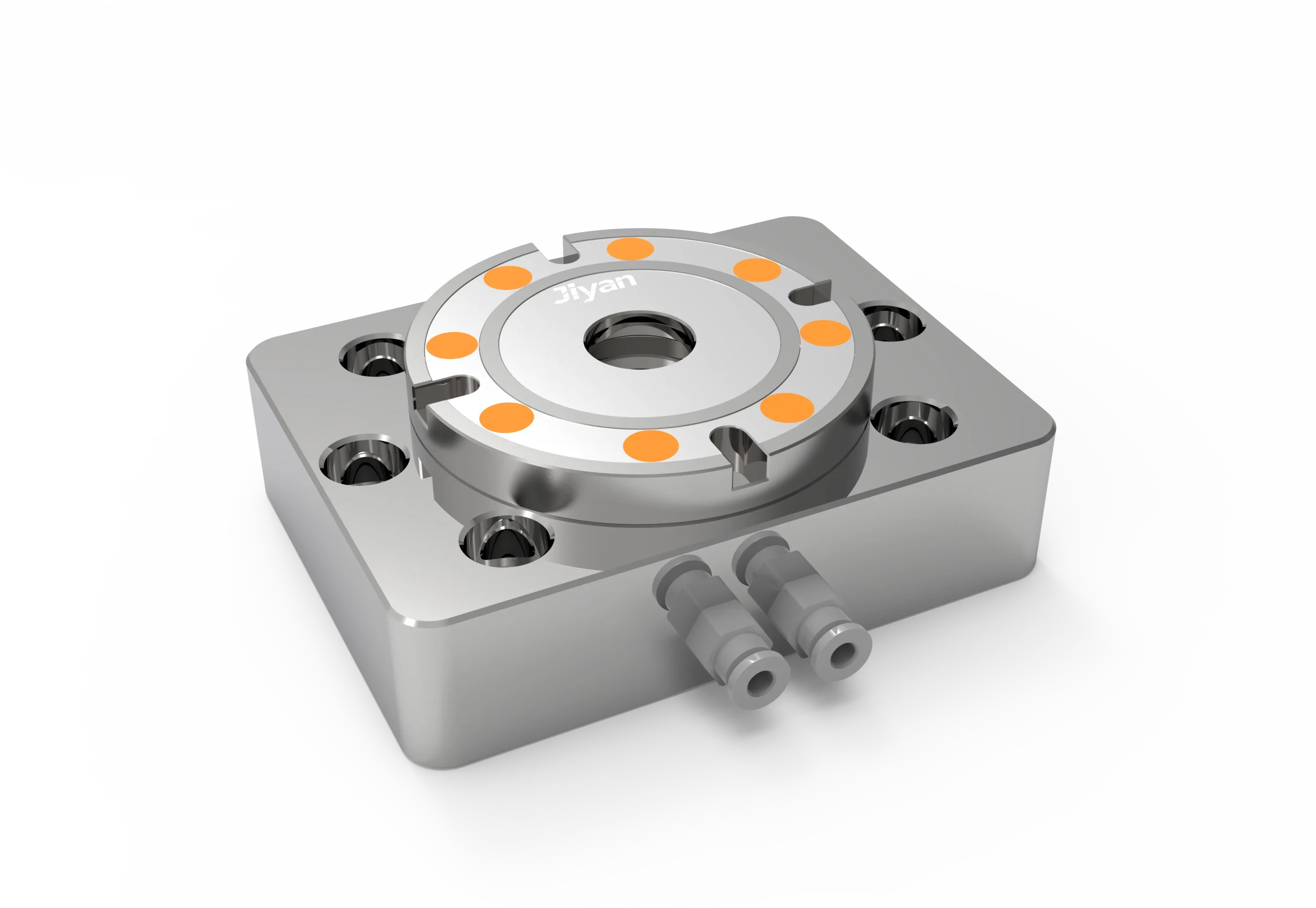
The JIYAN H18 self-centering vise — both jaws advance from a fixed centerline, so the workpiece is located automatically.
How a traditional CNC vise works
A traditional (or "single-acting") CNC vise has one fixed jaw and one movable jaw driven by a lead screw or hydraulic/pneumatic cylinder. You place the workpiece against the fixed jaw, then close the movable jaw to clamp.
That single fixed reference face is the whole story. Everything you machine is located relative to it. For an irregular blank or a part that needs a specific datum face held against a known wall, this is exactly what you want — the fixed jaw is your locating surface.
The trade-off is setup labor. On a traditional vise, the center of the workpiece shifts every time the stock size changes. If today's bar is 0.5 mm oversize, you re-indicate, re-edge-find, and re-zero. At volume, those minutes compound into hours.
How a self-centering vise works
A self-centering vise (sometimes called a "double-acting" or "centering" vise) drives both jaws simultaneously and symmetrically from a central, fixed midpoint. As you close it, the workpiece is pulled to the geometric center of the vise regardless of its width.
You no longer locate the part — the vise does. Drop a round bar, a hex, or a roughly sawn billet between the jaws and it ends up centered every time. That is the entire reason the design exists.
Because the centerline never moves, your X/Y zero can stay put across an entire batch even when stock varies. First-article setup becomes "drop it in and clamp," not "indicate, edge-find, re-zero."
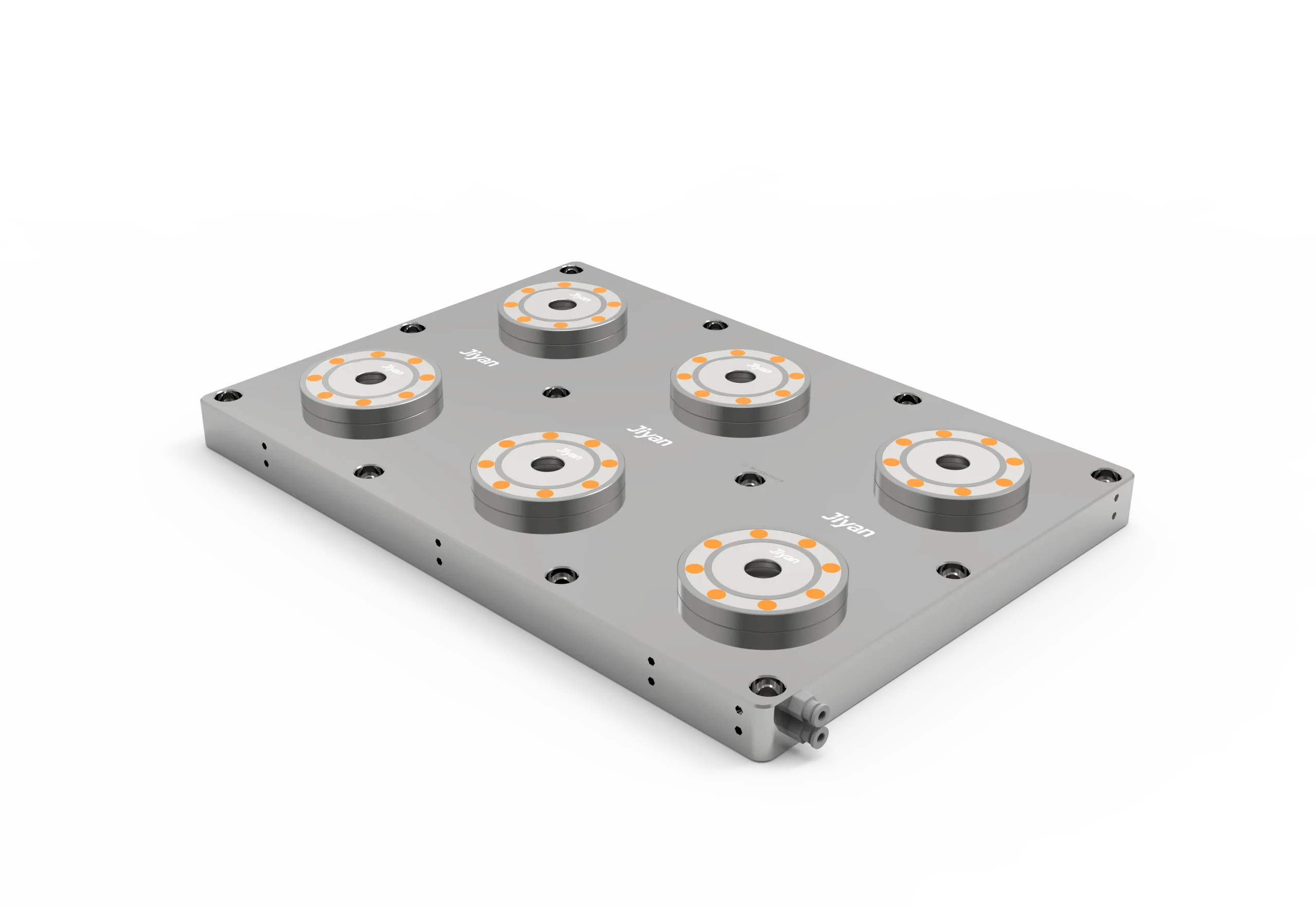
Self-centering designs scale into multi-station bodies — several independent centers in one fixture plate.
Self-centering vs traditional: the key differences
| Factor | Traditional CNC vise | Self-centering vise |
|---|---|---|
| Locating reference | Fixed jaw (you locate) | Central centerline (vise locates) |
| Best for | Irregular parts, datum faces | Symmetrical parts, batches |
| Setup per varying stock | Re-indicate + re-zero | None — center is fixed |
| Clamping-force balance | One-sided pull | Symmetric, no sideways drift |
| Thin/wavy stock | Can tilt or lift | Self-equalizing, stays flat |
| Typical repeatability | Depends on operator | ±0.01–0.02 mm typical |
| First-article time | Minutes | Seconds |
Neither is "better" in the abstract. They solve different locating problems. The mistake shops make is reaching for the traditional vise by default when the part is symmetric and the batch is real.
Clamping force and center finding
On a traditional vise the clamping force pulls the part toward the movable jaw as it seats — which can nudge a loosely placed workpiece off your intended zero if it wasn't firmly against the fixed jaw. Operators learn to "snug, tap, re-snug," and that ritual is precisely the time you're paying for.
A self-centering vise applies force equally from both sides. The part cannot drift sideways; it can only move along the centerline, which is exactly the axis you've already zeroed. For thin sheet, sawn plate, or anything that isn't a clean rectangular block, that symmetric pull keeps the stock flat instead of letting one corner lift.
Repeatability and first-article setup time
This is where the dollars live. A well-made self-centering vise holds a repeatability in the ±0.01–0.02 mm range (typical for ground-way center vises), and crucially that number is independent of who set it up. The center is a property of the mechanism, not the operator's feel.
On a traditional vise, repeatability is whatever your last edge-find delivered. Change operators, change stock, change your mood, and the zero wanders. For one-off prototypes that's fine. For a 200-piece run of bearing caps, it's the difference between "run it and forget it" and "check every fifth part."
Best use cases for each
Reach for a traditional vise when:
- The part is asymmetric or has a specific datum face that must seat against a wall.
- You're doing a one-off, a fixture-prototype, or a part with features referenced to a single known edge.
- You need maximum jaw opening for an oversized workpiece.
Reach for a self-centering vise when:
- The part is round, hex, square, or otherwise symmetric about a center.
- You're running a batch where stock size varies batch-to-batch.
- Setup minutes directly eat into spindle uptime (high-mix, low-volume job shops feel this most).
- You're building a palletized or multi-station fixture and want several fixed centers.
For shops running both profiles, the right answer is usually "both, on different fixtures" — not "one vise to rule them all."
The JIYAN H18 self-centering vise
The JIYAN H18 family is built around the center-finding principle above, with ground ways and a hardened center screw for stable repeatability across a long service life. It ships in single and multi-station bodies (the H18-6C carries six independent centers in one plate), so you can load a whole pallet of symmetrical parts and zero the machine once.
Two details matter for daily use:
- Pull-down seating. The jaw geometry pulls the part down onto the fixture datum as it centers, so thin stock stays put instead of lifting at the far corner.
- Fixed centerline, swappable jaws. Because the center never moves, you can swap soft jaws, serrated jaws, or step jaws without re-zeroing the machine.
If your work is mostly symmetrical components in batches — shafts, bushings, blocks, fittings — the H18 is the vise that turns setup from a chore into a non-event.
How to choose: a quick decision matrix
Answer three questions:
- Is the part symmetric about a center? If yes → self-centering. If no, and it needs a datum wall → traditional.
- Is this a batch, or a one-off? Batch → self-centering pays back fast. One-off → traditional is simpler.
- Does stock size vary between loads? Varies → self-centering removes re-zeroing. Constant → either works.
If you answered "self-centering" to two or more, the traditional vise in your drawer is costing you spindle time on that job.
Common questions
Will a self-centering vise hold an irregular part? Poorly — that's not its job. Locate irregular parts on a fixed jaw or a dedicated fixture. Use the centering vise for centered work.
Do I lose clamping force with both jaws moving? No. The center screw converts your input torque into equal force on both sides; total clamping force is comparable to a traditional vise of the same size.
Can I use it on a 5-axis machine? Yes. A fixed centerline is ideal for 5-axis because the part stays centered under the trunnion regardless of orientation. Pair it with a zero-point base for fast changeover.
Is the repeatability real or marketing? It's a function of the ground ways and center screw. A good unit holds ±0.01–0.02 mm; a worn or cheap one won't. Buy to the spec you'll actually inspect against.
Conclusion
The traditional CNC vise isn't obsolete — it's the right tool for located, asymmetric, one-off work. The self-centering vise wins the jobs it was designed for: symmetrical parts, varying stock, and batches where every re-zero is lost spindle time. Pick by locating problem, not by habit, and your setup sheet gets a lot shorter.
Ready to see what a fixed-centerline workflow does to your setup times? Talk to our team about the H18 family, or browse the full vise line.
If you are deciding between the two routes, start with the selection framework in the self-centering vise guide.