
Short answer: a zero point clamping system starts at $320 for a single 52 mm quick-change pallet and reaches $3,460 for a six-station pneumatic clamp. Most single-machine shops land between $600 and $1,500 — one clamp or base plus two to four pallets. Three things move that number most: grid size (52 or 96 mm), station count, and whether the system is manual or pneumatic.
Zero point clamping system price by configuration
Every figure below is a published list price from the JIYAN catalogue, so you can sanity-check a quote before you ask for one. Prices are in USD, ex-works Dongguan, November 2026.
| Configuration | Published price | Examples |
|---|---|---|
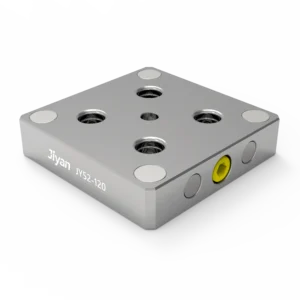
| 52 mm pallet — manual | $320 – $340 | JY52-116 round $320 · JY52-120 square $340 |
| 52 mm pallet — pneumatic | $610 | JY52-A125 square · JY52-A178 round |
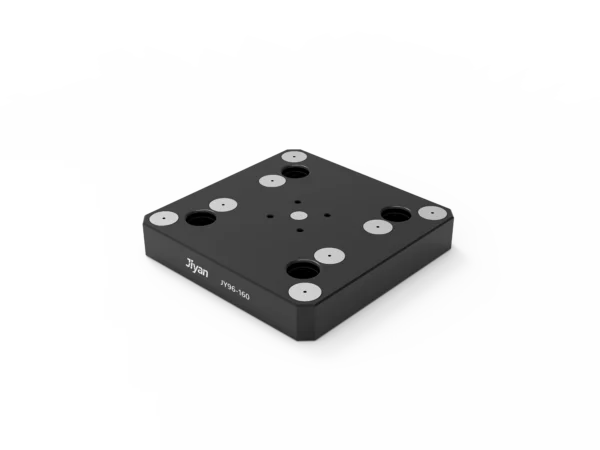
| 96 mm pallet — manual | $410 | JY96-160 square · JY96-176 round · JY96-192 long |
| 96 mm pallet — pneumatic | $740 | JY96-A180 square |
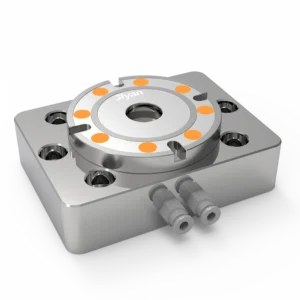
| Single-station pneumatic clamp, H18 | $410 – $520 | H18-1C long $410 · H18-1Y round $440 · H18-90-1L $520 |
| Single-station pneumatic clamp, H138 | $480 – $590 | H138-1C long $480 · H138-90-1L cube $590 |
| Two-station clamp | $680 – $1,720 | H18-2C $680 · H18-2L twin $760 · H138-2C $1,200 · H138-2L $1,720 |
| Four-station clamp | $1,330 – $1,620 | H18-4F flat · H18-4L cube |
| Six-station clamp | $2,360 – $3,460 | H18-6C · H138-6C |
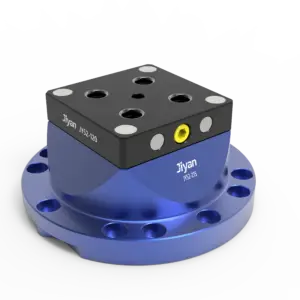
| Bases, 90° blocks, towers | $570 – $1,070 | JY52-L120 $570 · JY52-215 tower $590 · JY52-90B $1,070 |
| Entry accessories | $11 – $370 | H18-LD pull stud $11 · YW52-80 dovetail clamp $170 · JY96-ER32 holder $370 |
Four SKUs in the range are quote-only because they are built to order. A configured quote also covers air preparation, control valve, freight and duty, which are not in the list prices above.
What the money actually buys
Six systems from the same catalogue, one per price band — so you can see what the extra spend goes into. Every card opens the live product page with full specs and CAD.
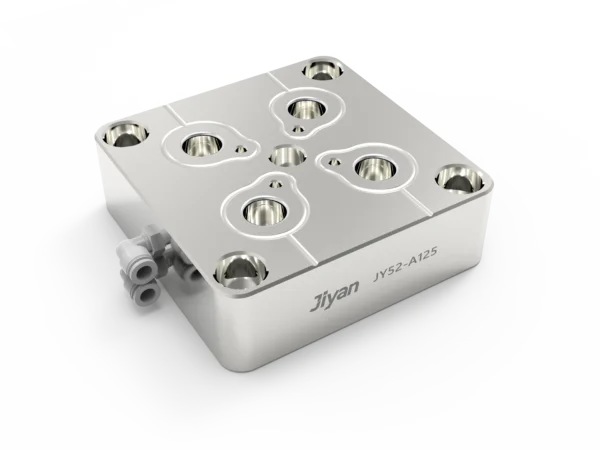
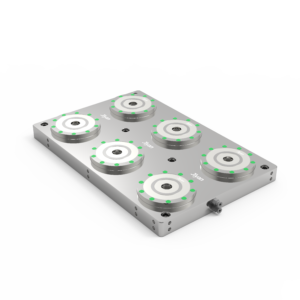
Looking for a different station count or body type? The full range is on the zero point system category page — 43 products from $11 pull studs to six-station cubes.
What actually drives the price
01 Grid size — 52 mm or 96 mm
The 96 mm grid carries roughly 60% more on the pallet than the 52 mm grid. The plate is larger steel, and the clamping pins, locating bores and clamp body scale up with it. If your parts fit inside a 52 mm pallet, the smaller grid is the cheaper system — and it takes up less table space on a small VMC.
02 Station count
One clamp body carrying two, four or six stations costs roughly three to eight times a single-station unit, but the cost per station drops. A two-station clamp is usually the best value per part if your cycle time allows batch loading.
03 Manual pallet or pneumatic clamp
A pneumatic clamp adds a piston, seals, air ports and a control valve, and typically costs around double the manual pallet at the same grid size. Add the air preparation unit and valve to the comparison — they are often quoted separately and can add a few hundred dollars.
04 Body type
A pallet moves between machine and bench. A base stays bolted to the table. A 90° block, cube or tower gives you extra faces for multi-side machining, and costs more because there is more machining and more locating surfaces per unit. Machined-from-solid bodies cost more than castings, and hold tolerance better.
05 Precision grade and heat treatment
±0.002 mm repeatability is not a marketing number — it comes from ground locating surfaces, hardened and stress-relieved steel, and inspection on every unit. This is the line item cheap copies skip, and it is why two systems that look identical can differ by hundreds of dollars.
06 Accessories and integration
Pull studs are per station, so a six-station clamp needs six. 4th-axis adapters, custom jaws, hydraulic conversion and machine-specific mounting plates are all priced on top of the base system.
Why two quotes for the same system can differ by 3×
In practice the gap is rarely about the clamp body. It is about what each quote quietly leaves out:
- One price is the pallet only; the other includes the fixed base that the pallet locks into.
- One includes the air preparation unit and solenoid valve; the other expects you to buy them locally.
- One guarantees ±0.002 mm; the other quotes ±0.01 mm and calls it “precision”.
- One has hardened, ground locating surfaces; the other ships soft steel that wears into play after a year of chips.
- One price is EXW; the other is CIF with duty and freight already in it.
If you have not settled on a system yet, read how a zero point clamping system works first — it covers the mechanism and the setup-time maths behind these numbers. Then come back here for the cost side.
How to read a zero point quote
Ask these six questions before you compare totals. They separate a real system price from a headline number.
- Is the fixed base included, or is this the pallet only? A pallet without a base does not clamp anything.
- Are pull studs included for every station? At $11 each they are small money, but a missing set stops the install.
- For pneumatic: are the air prep unit and solenoid valve in the price? Usually not, and they are not optional.
- What repeatability is guaranteed, and is there an inspection report per unit? If the answer is a range rather than a number, treat the spec as unverified.
- What is the warranty, and what does a spare seal kit cost? Seals are the one consumable in a pneumatic clamp.
- Which Incoterm, and who pays duty and freight? This alone can move a landed cost by 10–25%.
Which configuration fits which shop
| If you run… | Start with | Ballpark |
|---|---|---|
| One VMC, high-mix low volume | 52 mm manual pallet + base, 2–4 pallets | $600 – $1,400 |
| A cell with pallet changer or robot | Pneumatic single-station clamp + 4–6 pallets | $1,800 – $3,000 |
| 5-axis work, need part faces exposed | 52 mm riser tower or L-bridge plate | $570 – $780 |
| Long shafts, 4th-axis work | L-bridge plate pair on a 96 mm base | $780 – $1,500 |
Budget for two pallets, not one. A single clamp with a single pallet still stops the spindle to swap parts, so the second pallet is where the time saving actually comes from. If your budget only covers one pallet today, price the second one into the same purchase — buying it later costs the same and delays the payback.
A pallet change on a zero point system takes about 30 seconds against 20–40 minutes to re-indicate a vise from scratch. If you change setups three times a day, the arithmetic on a $1,000 system is usually measured in weeks, not years — do that math with your own hourly rate before you decide the system is expensive.
Frequently asked questions
How much does a zero point clamping system cost?
JIYAN systems run from $320 for a single 52 mm manual pallet to $3,460 for a six-station pneumatic clamp. A practical one-machine setup — one base or clamp plus two to four pallets — usually lands between $600 and $1,500, before air preparation, freight and duty.
Why is a 96 mm system more expensive than a 52 mm one?
The 96 mm grid uses a larger plate, bigger clamping pins and a heavier clamp body, so it costs roughly 60% more at the pallet level. It is worth the difference only when your parts or fixtures are too large to sit inside the 52 mm envelope.
Do I have to buy a pneumatic system, or can I start manual?
Start manual if you have one machine and change parts a few times a day — a manual pallet gives you the same 30-second changeover. Move to pneumatic when the system sits behind a pallet changer, a robot, or an operator running several machines at once.
What is not included in the listed price?
Air preparation unit and solenoid valve for pneumatic systems, pull studs for additional stations, 4th-axis adapters, custom jaws or fixtures, freight, insurance and import duty. Ask for a landed-cost quote rather than comparing ex-works numbers.
How accurate is a zero point system over time?
A hardened, ground system holds ±0.002 mm repeatability, but that only stays true if locating surfaces are kept clean and the clamps are not abused. Chips and coolant residue in the locating bores are the usual cause of drift, not wear.
How long does installation take?
Bolting a base to a clean table and checking squareness is a half-day job for one machine. Pneumatic systems add air line routing and valve installation, so plan a full day, plus a first-article check on your own parts.
What is the lead time?
Standard pallets and single-station clamps usually ship from stock; multi-station and cube bodies are built to order. Confirm the lead time in writing with your quote, especially if the system is tied to a machine installation date.
Is a zero point system worth it for a small shop?
If you change setups more than once a day, yes. The saving is not the pallet cost — it is the 20 to 40 minutes of re-indication you stop paying for every changeover, multiplied by machines and shifts.
What budget should I plan for my first system?
Budget $600 to $1,500 for one machine: a base or single clamp plus two pallets. Two pallets is the minimum that lets you load the next part while the spindle is still cutting. If you choose pneumatic, add a few hundred dollars for the air preparation unit and valve.
Get a configured price, not a headline number
Send the machine model, the parts you run and how often you change over. We will come back with a configuration, the station count that fits your cycle, and a landed price within one working day.
Related: zero point positioning system overview · how a zero point clamping system works · all workholding products