
Self-Centering Vise for 5-Axis CNC: Guide to Repeatable Accuracy
Self-Centering Vise for 5-Axis CNC: Buyer’s Guide to Repeatable Accuracy
If your 5-axis machine is sitting idle while an operator hunts for the centerline, the bottleneck isn’t your spindle — it’s your workholding. A self-centering vise is the single upgrade that turns “indicate the part, prove the offset, pray it holds” into a repeatable, sub-minute routine. This guide explains how self-centering vises work, why 5-axis machining depends on them, and how to choose one that actually pays for itself.
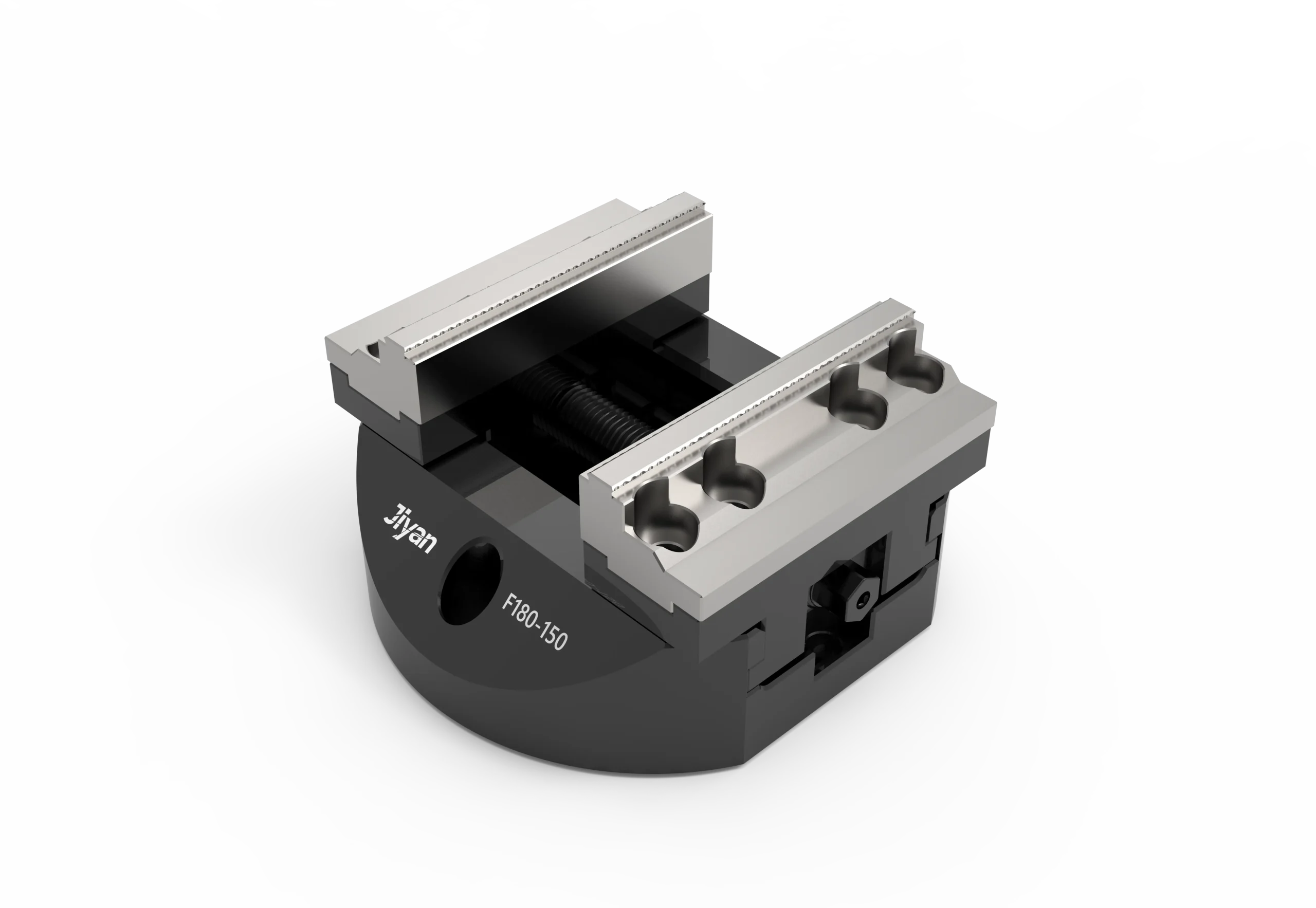
What Is a Self-Centering Vise (and How It Works)
A self-centering vise — sometimes written “self centring vice” or “centering vise” — is a precision workholding device that moves both jaws inward at the same rate when tightened. A central lead screw with left- and right-hand threads (or a wedge mechanism) drives the jaws symmetrically, so the workpiece lands on the geometric center of the vise body regardless of its actual width.
The key difference from a traditional vise: a conventional vise pushes the part against a fixed jaw, so centering depends on the operator. A self-centering vise removes the operator from the equation. Clamp it once, and the part is centered; clamp it the 1,000th time, and it’s centered the same way. That predictability is exactly what 5-axis machining needs, because every tilt and rotation of the workpiece multiplies any initial offset error.
Why 5-Axis Machining Needs a Self-Centering Vise
In a 3-axis world, a slightly-off centerline is annoying. In 5-axis machining, it’s expensive. Here’s why a self-centering vise for 5-axis CNC is effectively mandatory for tight-tolerance work:
- Single-setup multi-face access. 5-axis lets you machine five faces in one clamp. A bulky or off-center vise blocks tool paths and forces extra setups — which re-introduces the very alignment error you were trying to avoid.
- Error amplification. When the workpiece rotates and tilts, any centering error grows with the rotational radius. A 0.02 mm offset at the vise becomes a visible feature error on a tall part.
- Datum transfer. Palletized and automated cells reload the same fixture dozens of times per shift. Only a self-centering design delivers the same centerline on every cycle without re-indicating.
If you want the deeper background on the zero-point side of this story, see our guide to zero point clamping systems for 5-axis machining.
Self-Centering Vise vs Traditional Vise
This is the comparison every buyer asks about. The table below sums it up:
| Factor | Traditional Machine Vise | Self-Centering Vise |
|---|---|---|
| Workpiece alignment | Manual, against fixed jaw | Automatic centering |
| Setup time | Moderate to slow | Very fast |
| Repeatability | Operator-dependent | Excellent, cycle-to-cycle |
| Multi-side / 5-axis access | Limited | Superior |
| Automation readiness | Limited | High |
| Distortion risk on thin walls | Higher (one-sided force) | Lower (balanced force) |
The balanced clamping force is the quiet winner. Because both jaws pull inward equally, thin-wall aluminum and cosmetic surfaces deform far less than under a single-jaw squeeze. For a full head-to-head on traditional CNC vises, read our self-centering vise vs traditional CNC vise breakdown.
Manual vs Pneumatic Self-Centering Vise
One of the biggest buying mistakes is assuming “self-centering” only comes in a manual, screw-tightened flavor. It doesn’t — and the pneumatic self-centering vise is where the real productivity jump lives.
A pneumatic (air-actuated) self-centering vise replaces the tightening torque with regulated compressed air, typically 5–6 bar. A double-acting cylinder drives the jaw mechanism, and the centering geometry captures the part on-axis every cycle. The benefits are concrete:
- Constant clamping force. Force no longer depends on who tightened it or how hard. That eliminates one of the largest sources of part-to-part variation in manual cells.
- Cycle time. Clamp/unclamp drops from 15–45 seconds (manual) to 1–3 seconds (pneumatic).
- Automation. Pneumatic vises drop straight into robot-loaded and lights-out cells, with a pressure switch wired into the CNC as a clamp-confirm interlock.
- Thin-wall safety. Dropping line pressure to 2–3 bar with wide soft jaws spreads the load without marking delicate parts.
Manual still wins on simplicity and cost for low-volume jobbing. But if you run repeat families, a pneumatic self-centering vise pays back fast through reclaimed machine time alone.
Centering Accuracy and Repeatability: What the Numbers Mean
“Repeatability” gets tossed around loosely. Here’s what actually matters when you spec a self-centering vise with repeatable centering accuracy:
- Centering repeatability is the spread of where the workpiece center lands across cycles. Premium manual vises hit 0.01–0.03 mm; pneumatically actuated versions reach 0.005 mm or better.
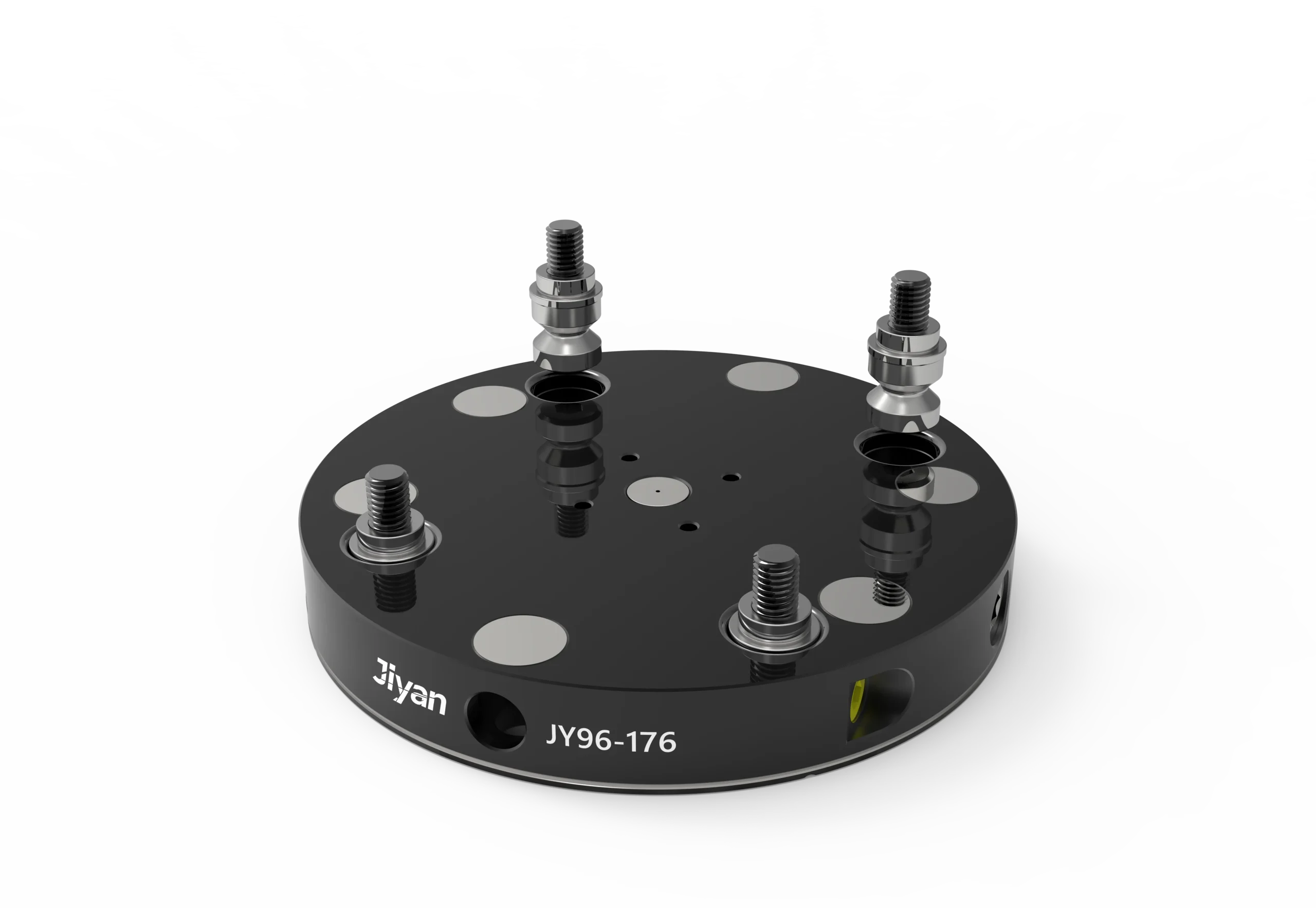
- Zero-point interface accuracy sets the floor for the whole stack. A zero-point base relocates pallets to within ~0.002–0.005 mm of a fixed datum — so the vise and the pallet together can rival a dedicated fixture.
- Torque consistency drives force stability. Use the same torque tool/procedure every time, or let pneumatics regulate it for you.
- Jaw condition is the silent killer. Inspect jaw faces and alignment periodically; worn serrations are the most common cause of “it used to hold, now it drifts.”
Rule of thumb: your total positional error is the sum of vise centering + interface + jaw wear. Attack all three, not just the headline clamp-force number.
How to Choose a Self-Centering Vise for 5-Axis CNC
Use this 5-axis self-centering vise selection guide as a checklist before you buy:
- Jaw width & stroke — match the real part family, not just your largest part. Oversizing the body steals tool clearance without adding value.
- Height / profile — low profile maximizes tool access around the lower half of the part. Confirm Z-height budget on your table, risers, or pallet.
- Zero-point compatibility — confirm the vise seats on your pallet or zero-point plate. This decides whether changeovers are seconds or minutes.
- Drive mechanism — manual for flexibility, pneumatic for volume and automation, hydraulic for heavy steel/titanium roughing.
- Jaw strategy — serrated for rough castings/forgings, soft jaws for finished/thin-wall surfaces, V-jaws for round stock.
- Repeatability spec — insist on documented centering accuracy (±0.005 mm or better for precision work), not just a clamp-force headline.
Buying for one ideal sample part is the classic trap. The right vise matches a repeat family of parts.
Pairing a Self-Centering Vise with a Zero-Point System
The combination is where 5-axis workholding clicks. Mount a self-centering vise on a zero-point base, and you get two wins at once: the vise centers the part, and the zero-point interface snaps the whole assembly back to the same datum after every changeover — no re-indicating, no proving cuts.
This is the setup we explored in the zero point clamping system guide: a zero-point module plus a self-centering vise is the fastest path to lights-out, high-mix 5-axis production. If you’re weighing the two investments, do them together — the vise is only as repeatable as the interface underneath it.
Jiyan Self-Centering Vise Solutions
Jiyan builds the full self-centering vise stack for 5-axis shops — from compact manual units to pneumatic self-centering vises and the zero-point bases that seat them:
- F-series self-centering vises (e.g., F80-150, F180-150) — symmetric-jaw vises engineered for low profile and maximum 5-axis tool access, with documented centering repeatability for precision work.
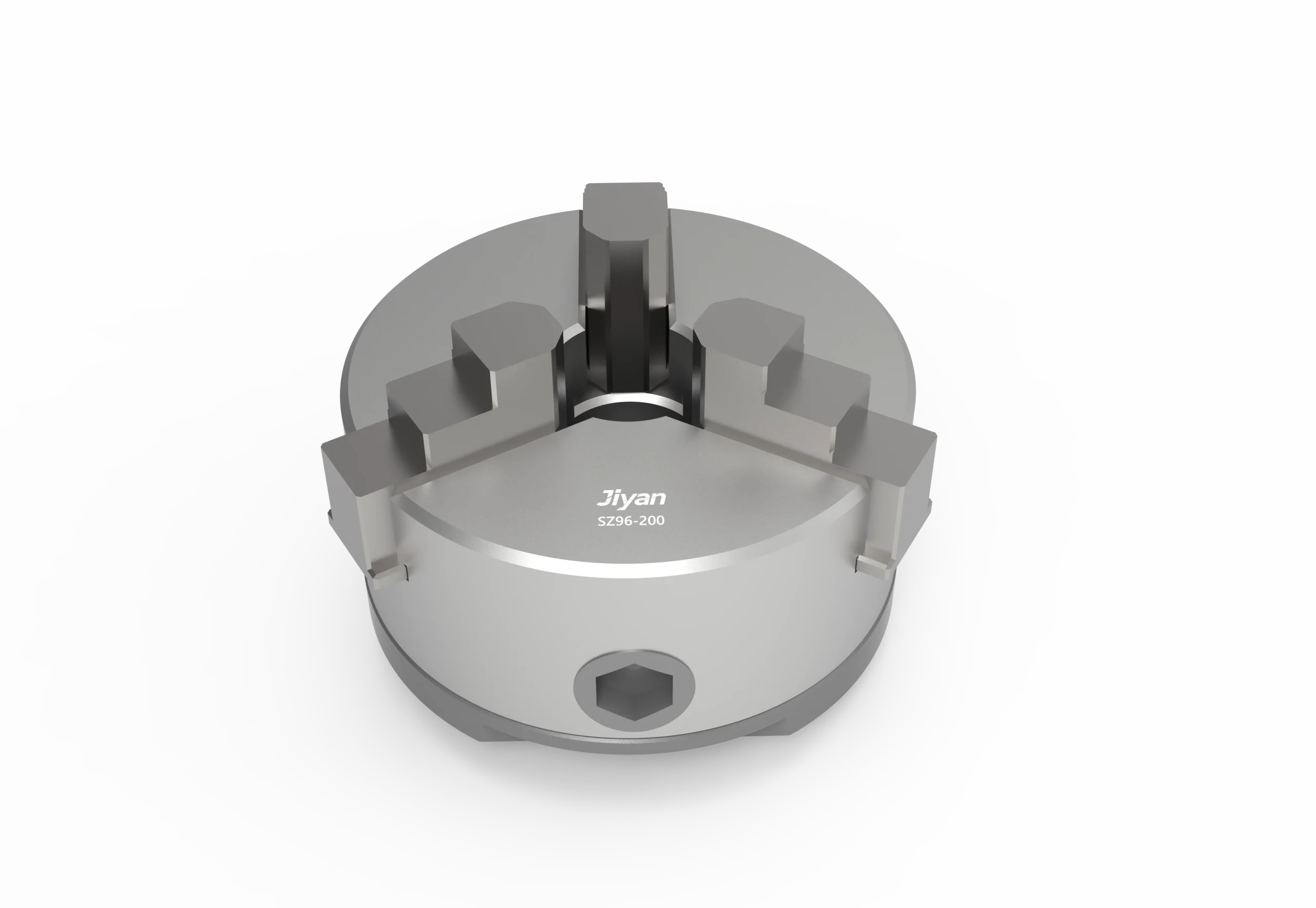
- SZ-series self-centering vises (e.g., SZ96-200) — wider-jaw models for larger prismatic parts that still require tight centering accuracy.
- Pneumatic clamping cylinders (YW series) — regulated-air actuation that turns a manual vise into an automation-ready, constant-force workholder.
- Zero-point bases & modules — the datum foundation that makes every vise swap repeatable to ~0.005 mm.
Whether you’re replacing a worn traditional vise or building a palletized 5-axis cell, Jiyan can spec a self-centering vise + zero-point combination matched to your part family.
This 5-axis take builds on the core operating principles covered in the self-centering vise guide.
FAQ
What is a self-centering vise used for?
It clamps parts symmetrically from both sides so the workpiece automatically centers on the vise axis. That’s ideal for 5-axis machining, multi-side milling, and any job where repeatable centering beats manual alignment.
Is a pneumatic self-centering vise worth it?
For repeat part families and automated cells, yes. Constant clamping force and 1–3 second clamp/unclamp times reclaim machine hours that manual tightening wastes. For one-off jobbing, a manual self-centering vise is usually enough.
How accurate is a self-centering vise?
Premium manual units reach 0.01–0.03 mm centering repeatability; pneumatic versions hit 0.005 mm or better. Total accuracy also depends on the zero-point interface and jaw condition.
Can a self-centering vise be used on a zero-point system?
Yes — and it should be. Mounting the vise on a zero-point base gives you automatic part centering and repeatable pallet relocation, which is the foundation of fast 5-axis changeovers.
Self-centering vise vs traditional vise — which is better for 5-axis?
The self-centering vise. It centers automatically, repeats cycle-to-cycle, and stays low-profile for tool access, whereas a traditional vise needs manual alignment and blocks more tool paths.
Conclusion
A self-centering vise is the highest-leverage workholding upgrade for any 5-axis shop: it centers the part automatically, repeats every cycle, and — paired with a zero-point system — turns changeovers into a seconds-long routine. Spec by your real part family, insist on documented centering accuracy, and consider pneumatics the moment volume or automation enters the picture.
Ready to spec your setup? Browse Jiyan’s self-centering vise and zero-point workholding range, or contact our team for a part-family recommendation. And if you haven’t read it yet, start with our zero point clamping system guide for 5-axis machining.