
Zero Point Clamping System for 5-Axis CNC: Setup Time Guide
Zero Point Clamping System for 5-Axis Machining: Cut Setup Time, Lock Precision
Every minute your 5-axis machining center spends being indicated back to center is a minute it is not cutting chips. For high-mix shops, that hidden cost quietly eats 30–50% of available spindle time. A zero point clamping system is the single upgrade that turns fixture changeover from a manual, error-prone ritual into a repeatable, measured step — and on a 5-axis machine, it protects the very accuracy the rotary axes are supposed to deliver.
This guide explains what a zero point clamping system is, how it works, why it matters specifically for 5-axis workholding, and how pairing it with a Jiyan self-centering vise lets you load, lock, and cut in seconds instead of minutes.
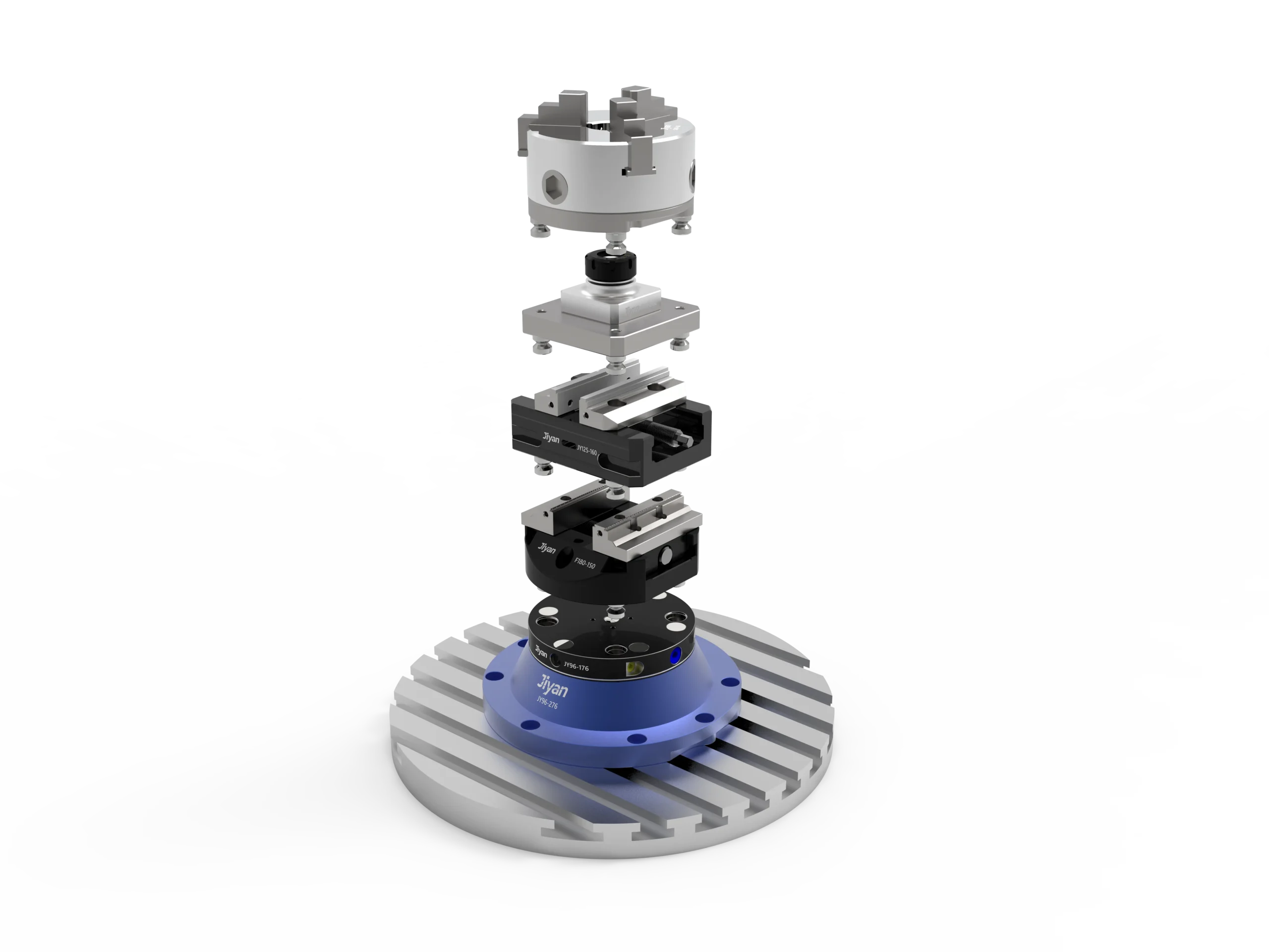
What Is a Zero Point Clamping System?
A zero point clamping system is a precision locating-and-locking interface that fixes fixtures, vises, or pallets to a predefined reference point on the machine table — the “zero point” — with micron-level repeatability. Once a fixture is dropped onto the interface, it returns to the exact same coordinate every time, with no indicating, no edge-finding, and no proving cuts.
A typical system has three parts:
- Receiver plate (base): bolted permanently to the machine table or pallet. Contains one or more clamping modules.
- Pull stud (locator): a hardened pin attached to the bottom of the fixture or vise.
- Clamping module (chuck): the mechanism in the receiver that pulls the stud down, self-centers it, and locks it with a verified seat.
Because the datum lives in the interface — not in the operator’s skill — the same fixture can move between the CNC, the CMM, and a deburring or EDM station and come back to the identical zero. That is the foundation of lights-out and palletized production.
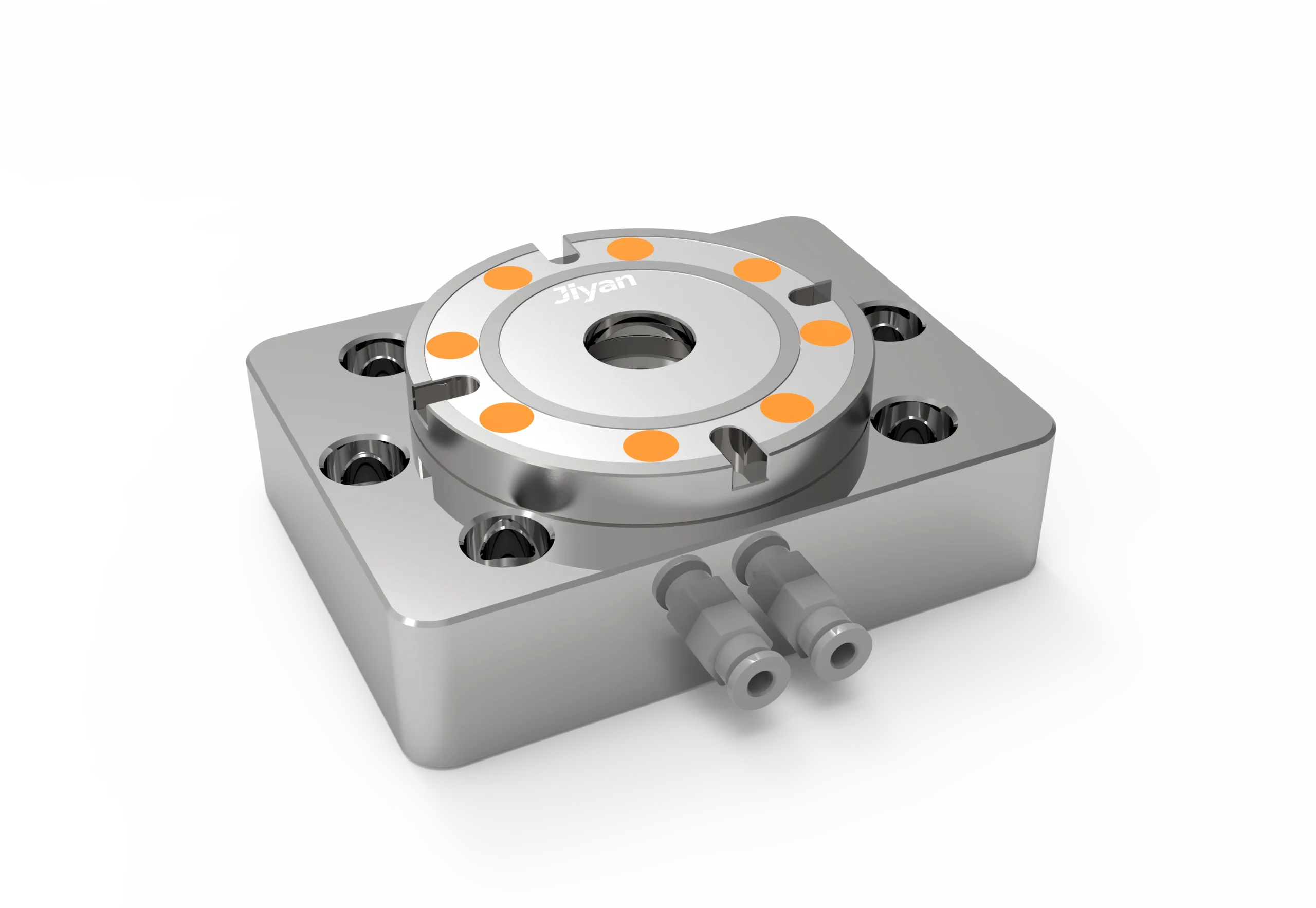
How a Zero Point Clamping System Works
When the pull stud enters the clamping module, a taper or locating seat centers it, and a spring-and-ball (or wedge) mechanism locks it down. Higher-end modules add pneumatic unlocking with mechanical self-locking, so clamping force survives an air-pressure drop — critical for unattended overnight runs.
Two specs decide whether a zero point clamping system is production-grade:
| Spec | Why it matters | Target for milling |
|---|---|---|
| Repeatability | Defines whether the pallet returns to the same zero after removal and re-clamp | < 0.005 mm (sub-5 µm for tight-tolerance cells) |
| Pull-down force | Resists vibration, chatter, and simultaneous 5-axis roughing without micro-lift | Enough to hold the pallet + part under your worst-case cutting load |
A good module also includes seat verification (air-pressure or proximity check) so the control knows the stud is fully locked before the spindle starts. If your changeovers still depend on a setter eyeballing the dial indicator, you are paying for spindle time that makes no parts.
Why 5-Axis Machining Needs Zero Point Workholding
On a 3-axis machine, a small datum error mostly shifts the part in X/Y. On a 5-axis machining center, the same error is amplified into an angular mistake the moment the rotary axis tilts — features cut from different approach angles no longer relate to each other, and suddenly a “0.05 mm” slip becomes a scrap part.
A zero point clamping system for 5-axis machining removes the human element from datum setting on your most accuracy-critical machine. It also unlocks the real reason shops buy 5-axis in the first place: machining five sides in one setup. With a fixed, verified zero, you can:
- Pre-set fixtures offline while the machine keeps cutting.
- Swap jobs in seconds without re-establishing offsets.
- Run pallet pools where any fixture drops onto any receiver and cuts the same.
- Hand changeovers to a robot or an inexperienced operator with confidence.
In short, 5-axis accuracy is only as good as the workholding beneath it. Zero point locating is what makes the rotary axes trustworthy.
Zero Point Clamping + Self-Centering Vise: The Productivity Combo
A zero point clamping system solves where the fixture sits. A self-centering vise solves how the part sits inside it. Put them together and you get the fastest, most repeatable 5-axis workholding stack available.
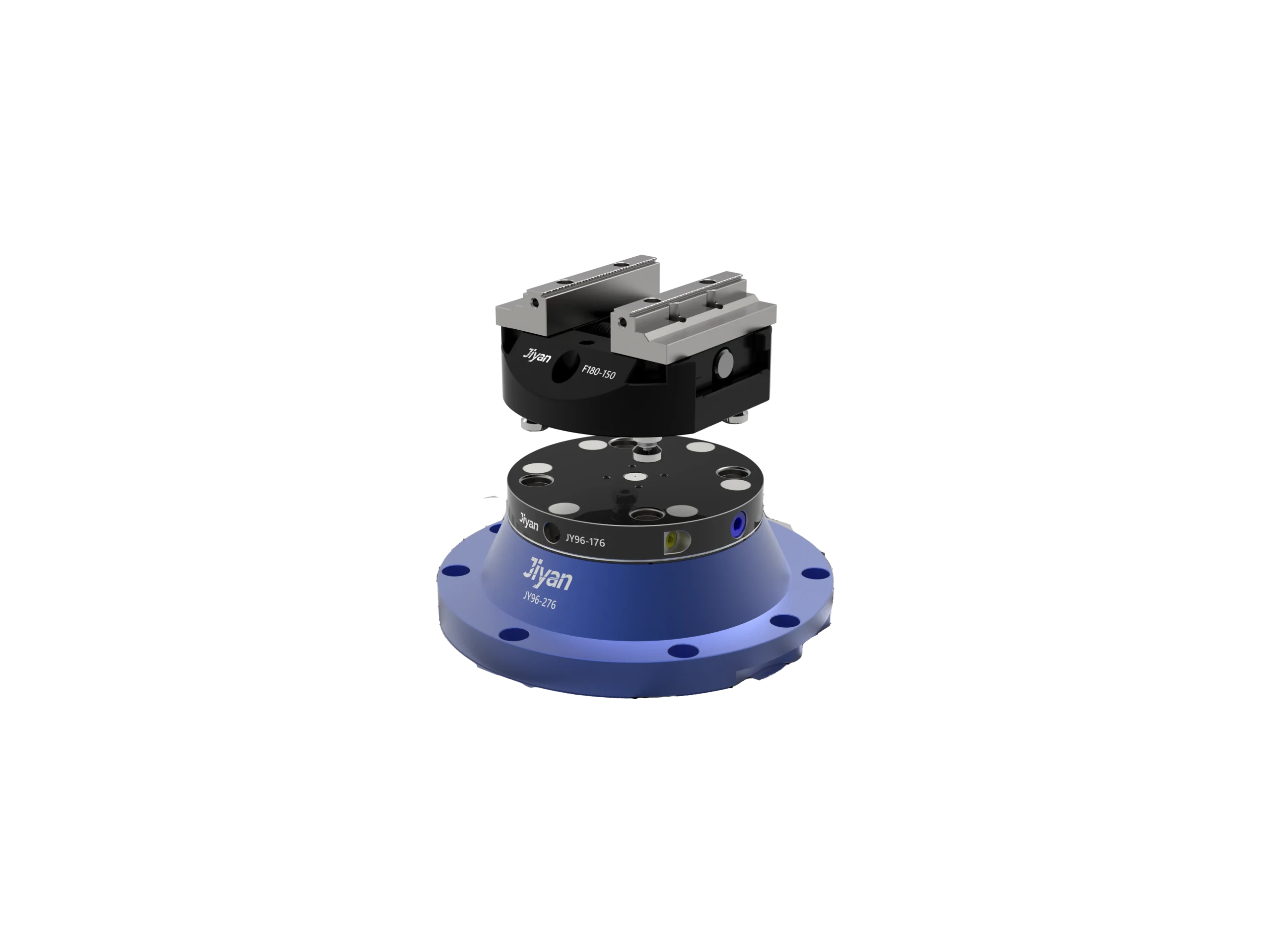
Here is the workflow a Jiyan 5-axis self-centering vise mounted on a zero point plate delivers:
- The vise is pre-loaded with soft jaws and the part is centered automatically by synchronized jaws — no manual indicating.
- The vise (with stud) is placed on the receiver; it pulls down, self-centers, and locks.
- The control verifies the seat, and cutting starts — often in under 30 seconds from last part to first good part.
- After inspection or a secondary op, the same vise drops back on and returns to the identical zero.
Because a self-centering vise keeps the workpiece on the machine centerline, it also maximizes tool clearance around the part — exactly what simultaneous 5-axis toolpaths need. For shops running round stock, thin-wall aluminum, or prismatic parts, this combination is the difference between “we can quote that” and “that’s too fiddly.”
Jiyan tip: Standardize every fixture in your cell to one pull-stud interface. Once the whole floor speaks the same zero-point language, any vise or pallet fits any machine — and changeover stops being a bottleneck.
Zero Point Clamping System vs Traditional Workholding
| Factor | Traditional (indicate by hand) | Zero Point Clamping System |
|---|---|---|
| Setup time | 10–30 min per changeover | Under 1 min |
| Datum accuracy | Operator-dependent | < 0.005 mm, every time |
| Multi-machine transfer | Re-indicate each time | Same zero across CNC/CMM/EDM |
| Automation fit | Poor | Built for lights-out |
| Skill dependency | High (needs a setter) | Low (load-and-lock) |
| Audit trail | None | Seat-verified, documented |
Traditional clamping is fine for a one-off prototype. For any shop doing repeat or high-mix work, the zero point clamping system pays for itself in recovered spindle time — most operations running three or more setups per day see payback inside 12 months.
How Much Setup Time Can You Actually Save?
The math is simple. Take your job changes per day, multiply by your current average setup time (in hours), then by your fully-loaded machine hourly rate, then by working days per year. That is your annual setup cost. Compare it to the cost of a zero point vise and receiver set.
A conservative 90% setup-time reduction — the figure established suppliers publish — means a machine that used to cut 4 hours of chip-making per shift can often add a full extra hour of cutting without any new iron. On a busy VMC, that is weeks of free capacity per year.
How to Choose a Zero Point Clamping System
Use this checklist before you buy:
- Repeatability: demand a documented test method, not just a catalog number. Target < 0.005 mm for milling.
- Pull-down force: match it to your heaviest roughing load; weak pull-down = micro-lift and chatter.
- Self-locking: prefer pneumatic unlock + mechanical lock so an air drop never releases a pallet.
- Chip/coolant protection: the interface should be sealed and self-cleaning.
- Zero-point compatibility: confirm your vises and pallets share one stud standard so the whole cell is interchangeable.
- Seat verification: built-in proof the stud is locked before the spindle moves.
- Supplier track record: choose a manufacturer with proven repeatability data and real after-sales support.
For 5 axis workholding, also check Z-height budget: a vise that is rigid on the table may become a collision risk once it sits on a zero point plate. Measure the stack-up before you commit.
Jiyan Zero Point Clamping & 5-Axis Workholding Solutions
At Jiyan, we build the two halves of the productivity stack as one coordinated system: precision self-centering vises engineered for 5-axis clearance, and the zero-point interfaces that let them drop onto any machine in your cell.
Our workholding line is built around the same principles this guide recommends:
- Jiyan 5-axis self-centering vises with low-profile bodies and synchronized jaws for automatic centering and maximum tool access.
- Pneumatic clamping cylinders and quick-change modules for repeatable, operator-independent locking.
- Four-sided tower (multi-station) fixtures that multiply parts-per-setup on a single zero-point base.
- Tight-tolerance repeatability validated per batch, so your quality auditor gets the documented proof modern aerospace, automotive, and medical programs require.
Whether you run a job shop tired of indicating parts by hand or an automated cell targeting lights-out production, a Jiyan zero point clamping setup is designed to shorten changeover and protect your datum on every tilt.
Explore the full range and talk to our application engineers about standardizing your fixtures to one interface: Jiyan precision workholding.
Start with the zero-point clamping system guide for how the clamping works, then scale it to five axes here.
FAQ
What is a zero point clamping system used for?
It locates and locks fixtures, vises, or pallets to a fixed reference point on a CNC table with micron repeatability, eliminating manual alignment and enabling fast, automated changeovers.
Can a zero point clamping system be used on a 5-axis machine?
Yes. A zero point clamping system for 5-axis machining is ideal because it removes operator-dependent datum error that would otherwise be amplified by the rotary axes, and it preserves tool access to multiple faces.
How accurate is a zero point clamping system?
Production-grade modules typically hold repeatability under 0.005 mm (5 µm). Ultra-precision cells specify sub-3 µm architectures.
Does a zero point clamping system work with a self-centering vise?
Absolutely. Mounting a self-centering vise on a zero-point plate combines automatic part centering with verified fixture locating — the fastest, most repeatable 5-axis workholding combination.
How long does payback take?
Shops running three or more setups per day commonly recover the cost of a zero point vise and receiver set within 12 months through recovered spindle time.
Conclusion
A zero point clamping system is not a luxury accessory — on a 5-axis machine it is the difference between trusting your accuracy and hoping for it. By removing manual datum setting, it cuts changeover from minutes to seconds, protects micron repeatability through every tilt, and makes lights-out production realistic. Pair it with a Jiyan self-centering vise and you standardize your entire cell to one interface that any machine, any operator, and any robot can use.
Ready to stop indicating parts by hand? Browse Jiyan 5-axis workholding solutions or read our complete guide to CNC vises and the self-centering vs traditional vise comparison.