
CNC Vise Maintenance: Keep Your Workholding Accurate for Years
A CNC vise is the quietest machine in your shop and the one most likely to wreck a job without anyone noticing. Spindles get calibrated, probes get checked, and tool tables get verified — but the vise that holds the part rarely gets more than a quick wipe. That gap is where scrap, runaway Cpk, and “it was fine yesterday” mysteries come from.
This guide covers a practical maintenance routine for self-centering pneumatic vises and multi-station zero-point clamping systems: what to clean, what to lubricate, what to measure, and how often. The goal is simple — keep repeatability in the low-micron range for the life of the tool, not just the first month.
If you are still choosing a vise, start with our CNC Workholding Buying Guide and the Self-Centering vs Traditional Vise comparison before you optimize something you have not bought yet.
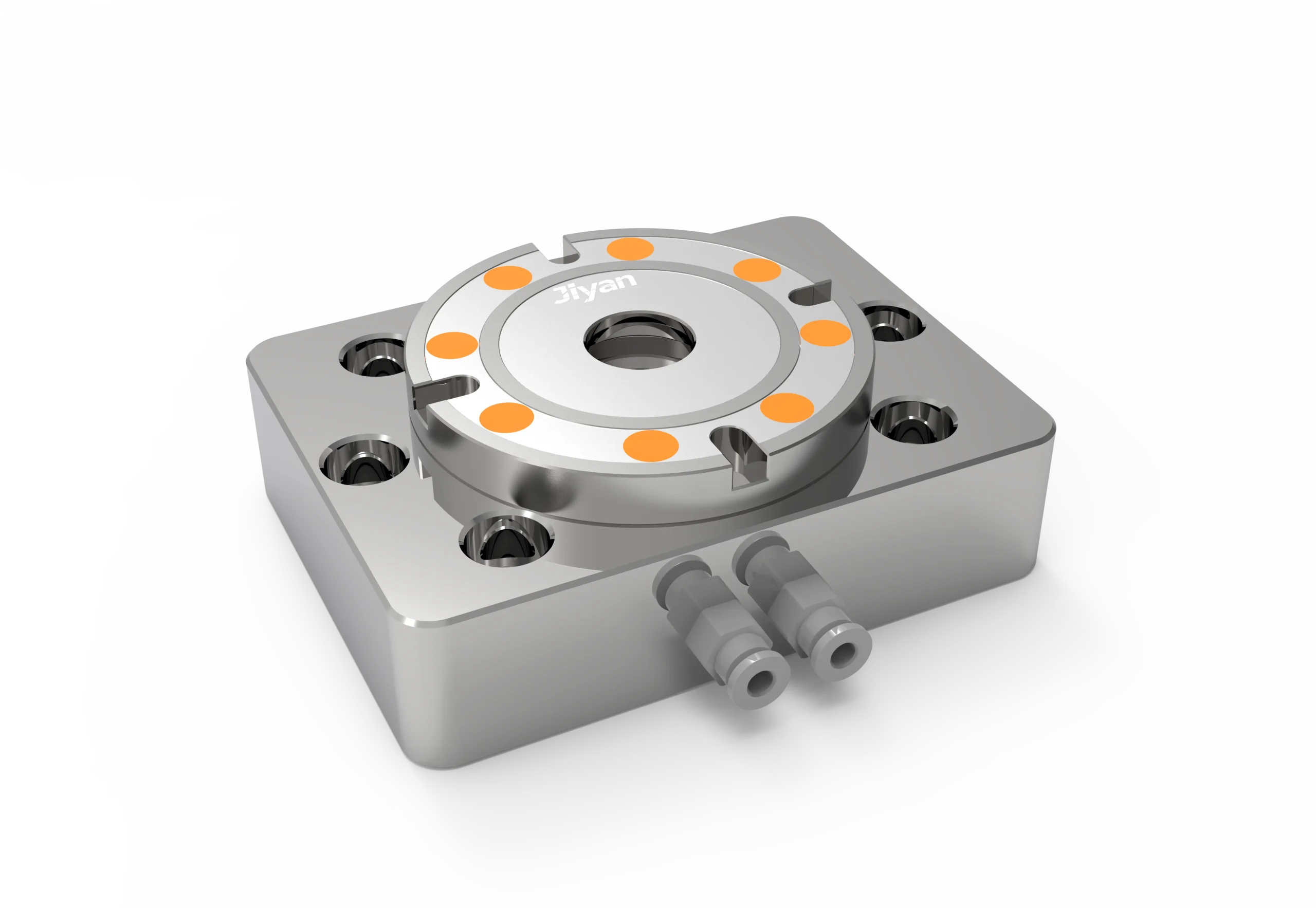
The JIYAN H18-1C self-centering pneumatic vise — a typical unit for a daily maintenance routine.
01 Why vise maintenance pays for itself
Repeatability degrades slowly. A vise that held ±0.005 mm at install can drift to ±0.02 mm over a year of chips, dried coolant, and jaw wear — still “good enough” by eye, but enough to push a tight-tolerance feature out of spec on a bad day. The cost is not the maintenance hour; it is the one part that ships out of tolerance.
A vise is also a force multiplier for every other investment you made. A €80,000 spindle is only as accurate as the thing clamping the stock. Ten minutes of care per shift protects the whole chain.
02 The daily routine (5 minutes, end of shift)
Do this every shift, no exceptions:
- Blow out the jaw ways and base. Compressed air, not a brush that pushes chips deeper. Pay attention to the serrations where the jaw meets the part.
- Wipe the datum faces. The fixed jaw face and the vise base (the surfaces your part and your indicator actually touch) must be clean and dry.
- Check for embedded debris. A single 0.1 mm chip under a jaw can throw a setup by ten times that. If a part “won’t seat,” assume a chip before you assume a bad vise.
- Cycle the pneumatic actuator once. Listen for hesitation or drift that signals a seal or pressure issue.
That is it for daily. The point is to stop chips from hardening into the mechanism overnight.
03 The weekly routine (15 minutes)
Once a week, go one level deeper:
- Remove and clean jaws. Take the jaws off, clean the mounting tongue and the jaw way, and confirm the jaw bolts are at spec torque. Loose jaws are the #1 cause of “it moved during the cut.”
- Inspect the serrations. Worn or rounded serrations lose grip and need more clamp force to compensate — which deflects thin parts. Replace jaws before they look “almost fine.”
- Lubricate the lead screw or actuator guide. A light film of way oil on exposed threads; for pneumatic units, a drop of pneumatic tool oil in the air line filter bowl.
- Verify clamp force roughly. Clamp a known indicator or test bar and confirm it seats repeatably. You are not measuring yet — you are confirming nothing changed.
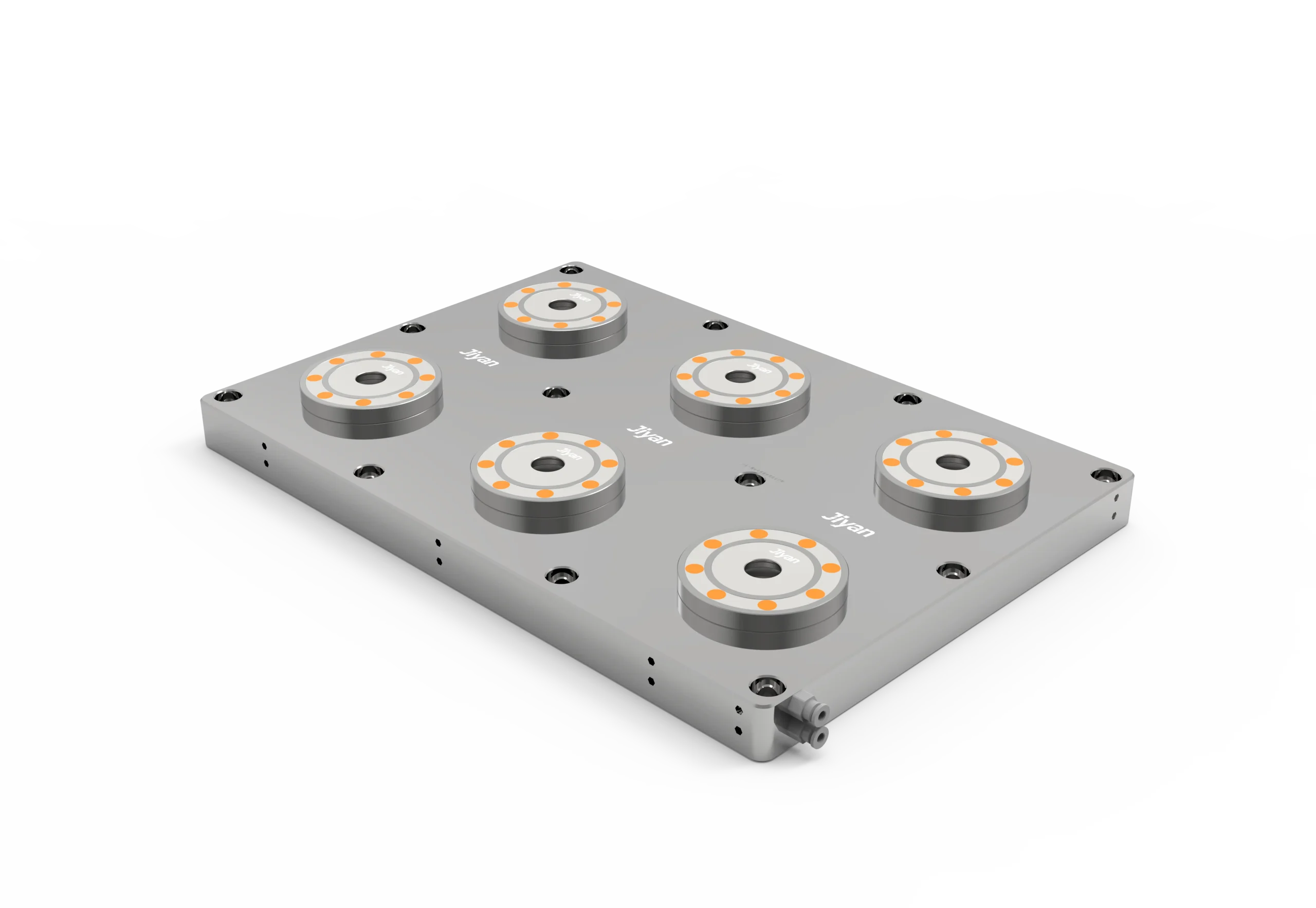
The H18-6C six-station unit — more clamping points means more surfaces to keep clean.
04 Monthly: measure repeatability, don’t assume it
This is where maintenance turns into data. Use a test bar or a calibrated ring and an indicator:
- Seat the reference part five times, re-indicating each time.
- Record the spread. For a quality self-centering vise you should see single-digit microns.
- Plot it. A trend line moving up over months tells you a component is wearing before a single part fails.
If you run a zero-point clamping system, measure pallet exchange repeatability the same way — seat the pallet five times and read the datum. Sub-5-micron is the target; anything creeping toward 10 µm warrants a pull-and-clean of the locating faces.
05 Lubrication: the right amount, in the right place
Too much lube is as bad as too little. Excess oil collects abrasive grinding dust; a dry way wears. The rule:
- Exposed threads and guides: thin way oil, wiped, not flooded.
- Pneumatic actuators: tool oil in the line filter only, per the air prep spec.
- Sealed bearings and the locating cone of a zero-point base: leave them alone. If they need grease, they were specified wrong.
Never, ever lubricate the jaw serrations or the datum face. Grip comes from metal-on-metal; oil there guarantees slippage.
06 Pneumatic systems: air is the hidden variable
Most “vise problems” in pneumatic shops are actually air problems. Check:
- Line pressure at the vise, not at the regulator. A long line or a shared drop can sag 1–2 bar under flow. Clamp force scales with pressure, so a saggy line is a saggy grip.
- The filter bowl. Water and oil emulsion in the bowl means moisture is reaching seals. Drain it, then fix the dryer.
- Leak-down. Close the vise, shut the line, and time how long it holds. If it relaxes in seconds, you have a seal or fitting leak that will bite you mid-cut.
If you are comparing actuation types, our Pneumatic vs Hydraulic Vise breakdown covers why pneumatic is usually the lower-maintenance choice for high-volume work.
07 Multi-station and pallet systems: clean the datums
A six-station or palletized vise multiplies the number of surfaces that matter. The failure mode is subtle: one station’s datum gets a burr, and suddenly station 3 repeatably throws a feature by 0.01 mm while the others are perfect. That looks like a “part problem,” not a “vise problem.”
- Clean every station’s locating face every week, not just the one you noticed.
- 标记 stations if you see a pattern — a simple log of which station drifts tells you which to rebuild first.
- Keep pallets paired to bases. Mixing pallets between bases is fine for the system, but if you see drift, isolate one pallet/base pair to find the culprit.
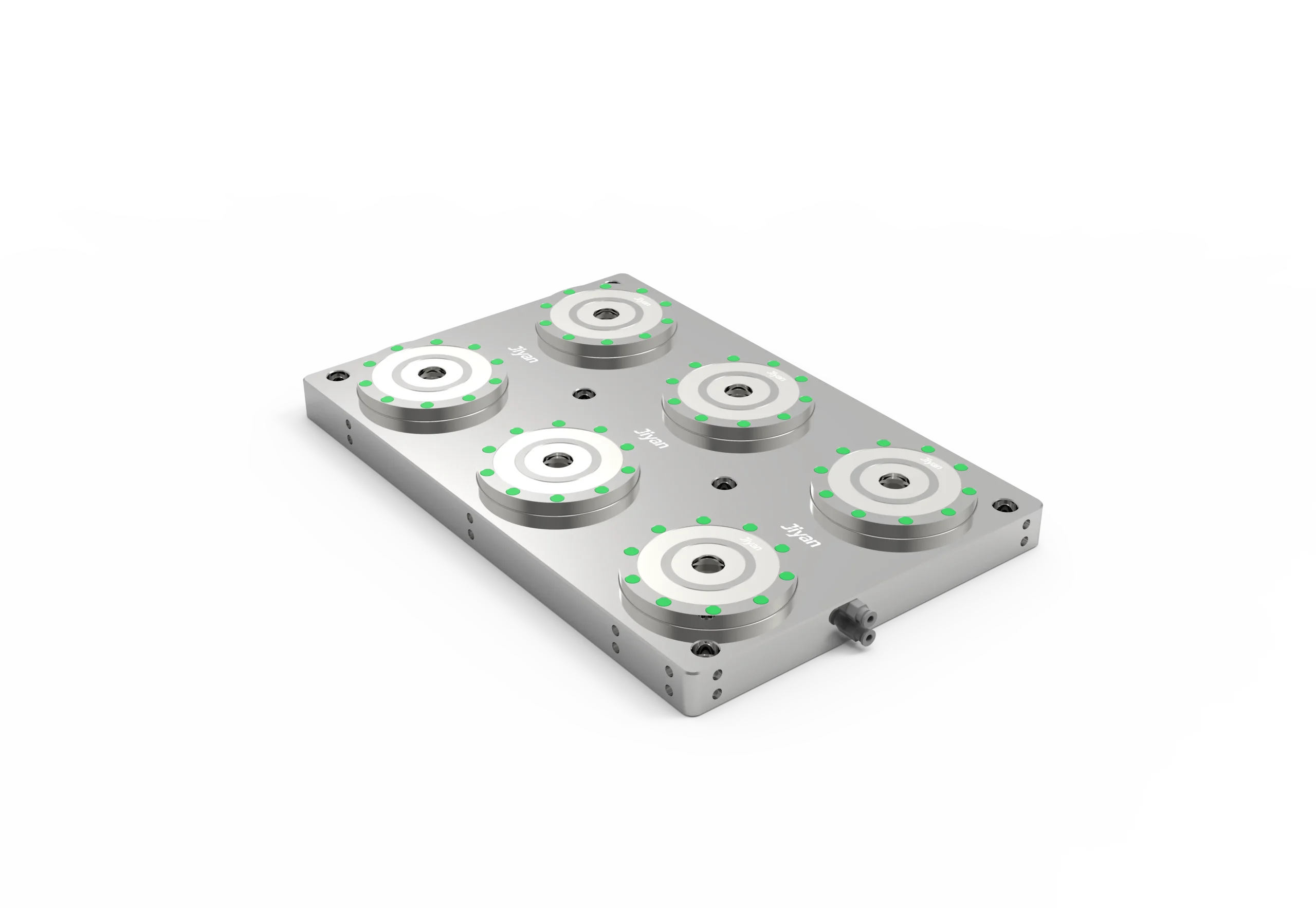
The H138-6C — each station’s datum face is a separate surface to keep clean and measured.
08 Storage and standby
Vises left sitting collect condensation and dust in the ways:
- Store with jaws slightly open and a light oil film on exposed steel.
- If a vise will sit unused for a season, cycle it monthly so seals stay soft.
- Keep the base mounting surfaces protected — a scored mounting face transfers error to every part you ever mount on it.
09 Troubleshooting the common complaints
| Symptom | Likely cause | Fix |
|---|---|---|
| Part moves mid-cut | Loose jaw bolts or oily serrations | Torque jaws, degrease serrations |
| Repeatability crept up | Worn serrations or dirty datum | Replace jaws, clean datum, re-measure |
| Vise won’t hold pressure | Air leak or seal | Find leak, repair line |
| One corner low | Chip under jaw or twisted stock | Clear chip, check stock flatness |
| Drift only on one station | That station’s datum burr | Clean/replace that station’s locator |
10 When to rebuild vs replace
A quality vise is rebuildable: jaws, seals, and guide ways are wear items, not the whole tool. Rebuild when:
- Repeatability is out but the base and guide are true (new jaws + seal kit restores it).
- The casting and the locating faces are sound.
Replace when the base datum or the guide way itself is scored or twisted — that is the structure, and no kit fixes structure. Buy once, maintain forever, and a good vise outlives the machine it sits on.
11 A simple maintenance log that actually gets used
The best program is the one a tired operator will follow at 4 p.m. on a Friday. Keep it stupid-simple:
- A laminated card at the machine: daily (5 min) and weekly (15 min) checks.
- A one-line-per-week log: date, who, repeatability reading, anything odd.
- A red tag: any vise that fails the weekly seat test comes off the machine immediately.
Free workholding maintenance checklist
Want the daily/weekly/monthly checklist as a printable one-pager for your shop floor? Contact JIYAN and we will send the PDF plus torque specs for your specific vise model.
12 Bottom line
Vise maintenance is cheap insurance on your most-used and least-watched tool. Five minutes a day, fifteen a week, a measurement a month — that is the difference between a vise that holds ±0.005 mm for a year and one that quietly drifts you into scrap. Pair the routine with quality hardware: a self-centering pneumatic vise or a zero-point clamping system gives you fewer surfaces to maintain and tighter repeatability to protect.
Ready to standardize your workholding? Talk to JIYAN about the right vise and a maintenance plan that fits your shifts.
Maintenance keeps a vise accurate, and the CNC vise guide covers the design choices that make upkeep predictable.