
Pneumatic vs Hydraulic Vise: Which Wins for High-Volume CNC
Ask a room of machinists and you will get a room of opinions on pneumatic vs hydraulic vise clamping. Both hold parts. Both can crash a part if set wrong. The difference that matters is not which is simply “stronger” — it is which one fits the way your shop actually runs, and which one will still make sense after a year of production and maintenance.
This comparison is for shops weighing a pneumatic CNC vise against a hydraulic CNC vise for high-volume work. It covers the practical trade-offs in clamp force, cycle speed, cleanliness, maintenance, and total cost of ownership, plus where a pneumatic self-centering vise earns its place in a production cell.
Pneumatic vs Hydraulic Vise: What Is the Difference?
A pneumatic vise uses compressed air to actuate its clamping mechanism. A hydraulic CNC vise uses pressurized hydraulic fluid to generate clamping force. Both can be integrated into CNC workholding and automation, but they suit different production priorities.
Hydraulic vises have a long reputation for high and consistent clamp force, especially in heavy ferrous machining. Modern pneumatic workholding has expanded well beyond light-duty applications. When correctly sized and regulated, pneumatic systems can provide sufficient and repeatable clamping for many aluminum, stainless steel, and light-to-moderate steel machining applications.
So the better question is not simply “which is stronger?” It is: for 因此,更恰当的问题并非简单的“哪个更强?”,而是:对于your parts, your production volume, and your车间而言,哪个系统能够为您提供合适的夹持力、循环时间、可靠性和维护性组合? shop floor, which system gives you the right combination of holding force, cycle time, reliability, and maintenance?
If you are still deciding between a self-centering and a traditional vise, start with our 如果您还在纠结是选择自定心虎钳还是传统虎钳,请先查看我们的self-centering vs traditional vise comparison。.
| Factor | ||
|---|---|---|
| 因素 | Pneumatic CNC Vise | Hydraulic CNC Vise |
| Actuation | Compressed air | Pressurized hydraulic fluid |
| Cycle speed | Fast | Moderate to fast, depending on system |
| Clamp force | Moderate to high when correctly sized | High to very high |
| Repeatability | High with regulated air pressure | High with regulated hydraulic pressure |
| Fluid management | No hydraulic oil | Requires hydraulic fluid and related components |
| Maintenance | Generally simple | More components to maintain |
| Best fit | High-volume production and automated cells | 重度粗加工和高力应用 |
| Heavy roughing and high-force applications |
How Does a Pneumatic CNC Vise Work?
A pneumatic CNC vise is driven by shop air through a cylinder or pneumatic actuator. Regulated air pressure produces a repeatable clamping action, while the jaw and workholding geometry determine how that force reaches the part.
The practical advantages are speed and cleanliness. There is no hydraulic oil to manage, no hydraulic power unit to heat the cell, and no fluid disposal. A properly configured double-acting pneumatic cylinder can open and close very quickly, which matters when a production job repeats hundreds or thousands of cycles.
For high-volume CNC work, the value of pneumatic workholding is therefore not just the movement of the jaw. It is the ability to repeat the same clamping process as part of a standardized production cycle.
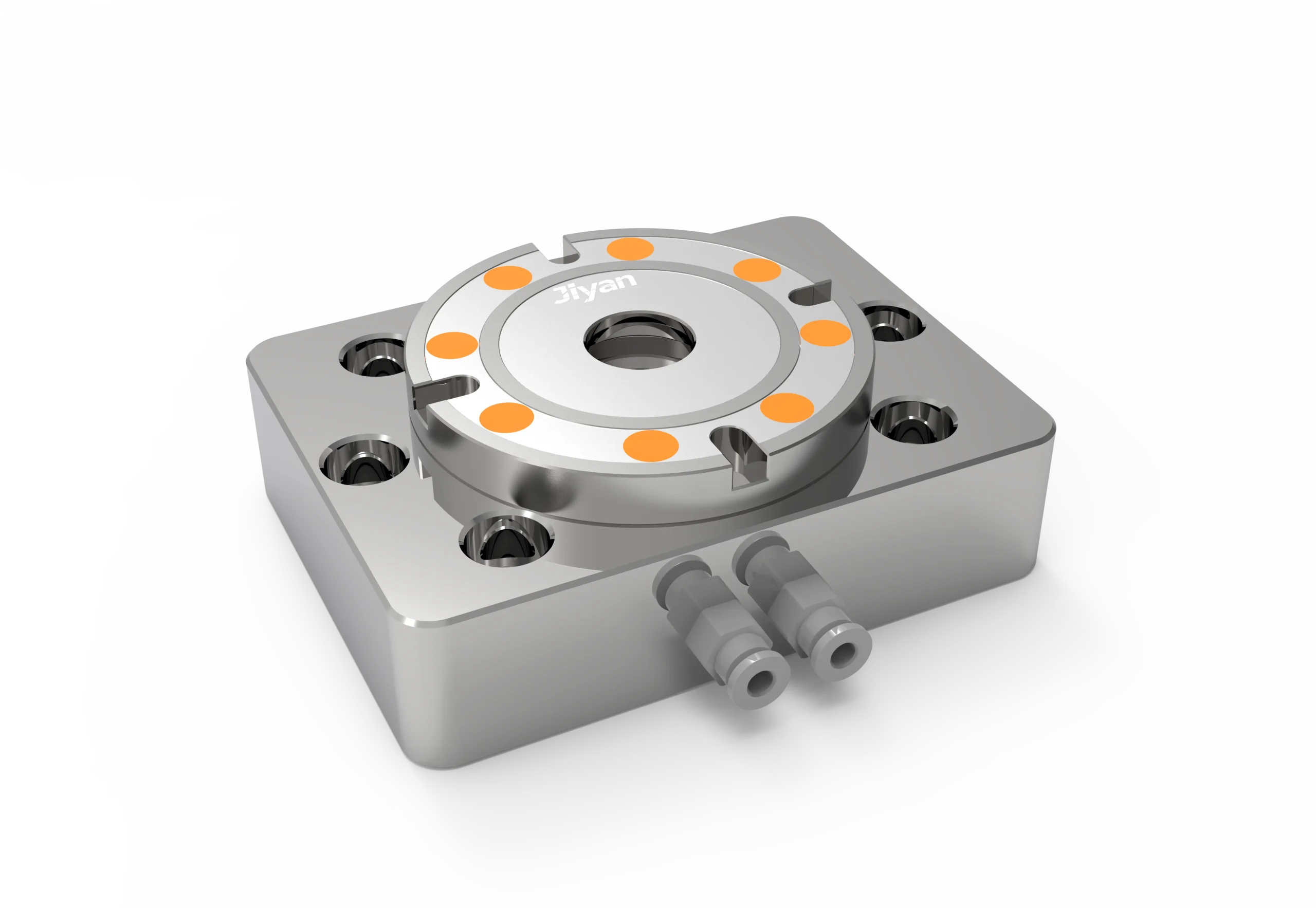
The H18-1C pneumatic vise: air-driven, fast-stroking, and clean on the floor.
How Does a Hydraulic CNC Vise Work?
A hydraulic CNC vise uses a hand pump, power unit, or hydraulic cylinder to move pressurized fluid and generate clamping force. Because hydraulic systems can operate at high pressure, they are well suited to applications where strong holding force is a primary requirement.
The main advantage is force and holding stability under demanding roughing conditions. The trade-offs include the hydraulic power unit, fluid, seals, hoses, and additional maintenance requirements. System design also affects actuation speed, so a powered hydraulic setup can perform very differently from a manually operated hydraulic vise.
For heavy steel roughing or applications with unusually high cutting forces, a properly sized hydraulic CNC vise can still be the better choice.
Pneumatic vs Hydraulic Vise: Clamp Force and Consistency
On paper, hydraulic systems generally have the advantage when maximum clamp force is the primary requirement. In production machining, however, consistency is often more useful than maximum force.
A properly regulated pneumatic system can provide highly repeatable clamping force from cycle to cycle. The same principle applies to a hydraulic system when its pressure is properly controlled. The important point is that the workholding system should provide enough force for the cutting conditions while avoiding unnecessary deformation or part movement.
For high-volume production, known and repeatable clamping force helps make the process predictable. The correct choice depends on the required force, part geometry, cutting conditions, and safety margin rather than on the drive technology alone.
Pneumatic vs Hydraulic Vise: Speed and Cycle Time
Cycle speed is one of the strongest arguments for pneumatic workholding. Air-powered actuation can move quickly and repeat quickly, making it well suited to repetitive production cycles.
On a job with hundreds of cycles, even a small reduction in clamping and unclamping time can add up to meaningful production time over a week. This becomes especially important when the vise is integrated with automated loading and unloading.
Hydraulic systems can also be automated and can provide fast actuation when properly engineered. The difference is that pneumatic systems are often attractive when the production priority is rapid, repeatable clamping without the additional infrastructure of a hydraulic power unit.
Pneumatic vs Hydraulic Workholding: Cleanliness, Heat and Shop-Floor Maintenance
Hydraulic workholding requires attention to fluid management, seals, hoses, and the hydraulic power unit. Power units can also generate heat and noise during operation. These are manageable engineering considerations, but they become part of the maintenance routine for a production cell.
Pneumatic workholding does not require hydraulic fluid. The system uses compressed air and can therefore reduce the risk of oil contamination around the machine and workholding area.
For shops building clean, automation-ready CNC cells, this can be a practical advantage. Pneumatic workholding also pairs naturally with zero-point and pallet systems, where fast clamping and repeatable positioning support short changeover cycles. See our quick-change zero-point guide for the broader workholding system.
Pneumatic vs Hydraulic Vise: Maintenance and Total Cost of Ownership
Hydraulic systems typically include more components that require maintenance, such as pumps or power units, fluid, seals, and hydraulic lines. Pneumatic systems commonly use a cylinder, regulator, valves, and air lines, although the exact configuration varies by application.
In many high-volume cells, pneumatic systems can offer a lower maintenance burden because they eliminate hydraulic fluid and hydraulic power-unit components. However, the actual total cost of ownership depends on the initial equipment cost, compressed-air requirements, production volume, maintenance schedule, and the force requirements of the job.
Hydraulics can still be the better investment for a dedicated heavy-roughing station where the additional force capability provides clear production value.
Which Vise Is Best for High-Volume CNC Machining?
For high-volume CNC machining with repeated cycles, mixed materials, and a strong focus on fast loading, pneumatics are often the practical starting point. A hydraulic CNC vise remains attractive when heavy roughing and maximum holding force dominate the application.
Most shops do not have only one type of job. A practical strategy can be to use pneumatic workholding as the default for repetitive production and automated cells while reserving hydraulic workholding for operations that genuinely require higher force.
Why Choose a Pneumatic Self-Centering Vise?
A pneumatic self-centering vise combines the fast actuation of pneumatic clamping with automatic part centering. Instead of relying on the operator to position every part against a fixed jaw in exactly the same way, the opposing jaws move toward the centerline and help establish a repeatable part position.
This can be especially useful in production machining, where reducing small setup variations across many cycles can improve consistency and simplify loading.
Faster and More Repeatable Part Loading
A pneumatic self-centering vise can simplify the loading sequence because the part is guided toward a repeatable center position during clamping. This is useful when the same part is loaded repeatedly or when the workholding system is being supplied by an automated loader.
Consistent Part Location for Production Runs
Self-centering workholding can reduce a common source of setup variation: inconsistent manual positioning. It does not replace proper workholding design, stops, jaw selection, or process validation, but it can make repeated loading more predictable.
Pneumatic Workholding for Automated CNC Cells
Pneumatic workholding is a natural fit for automated CNC cells because clamping and unclamping can be controlled as part of the machine cycle. Multi-station configurations can further increase the number of parts available for each cycle.
The H18-6C six-station pneumatic vise takes this approach further by running multiple stations from one air source for higher part density.
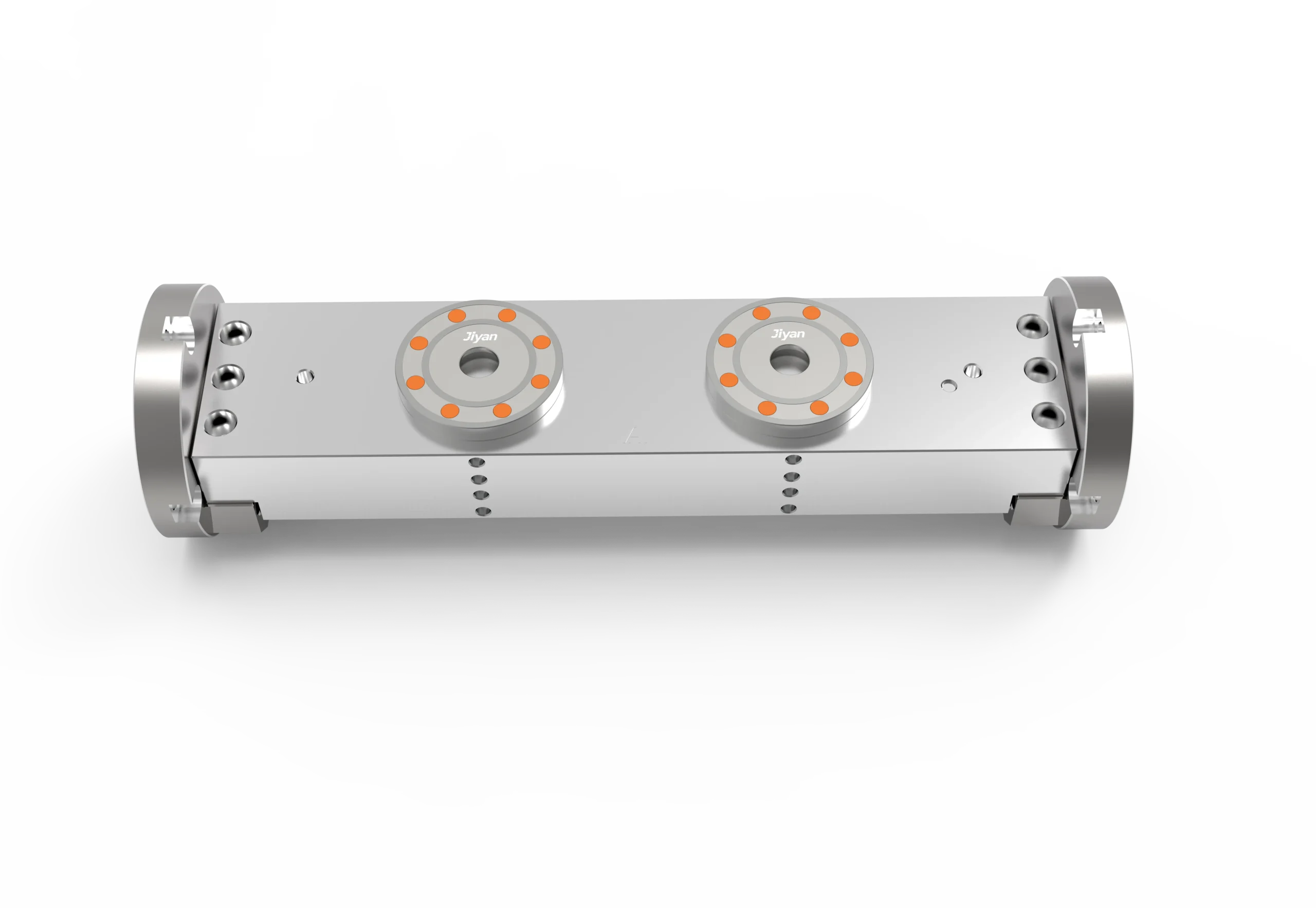
A double-sided zero-point pallet flips a self-centered part without re-indicating.
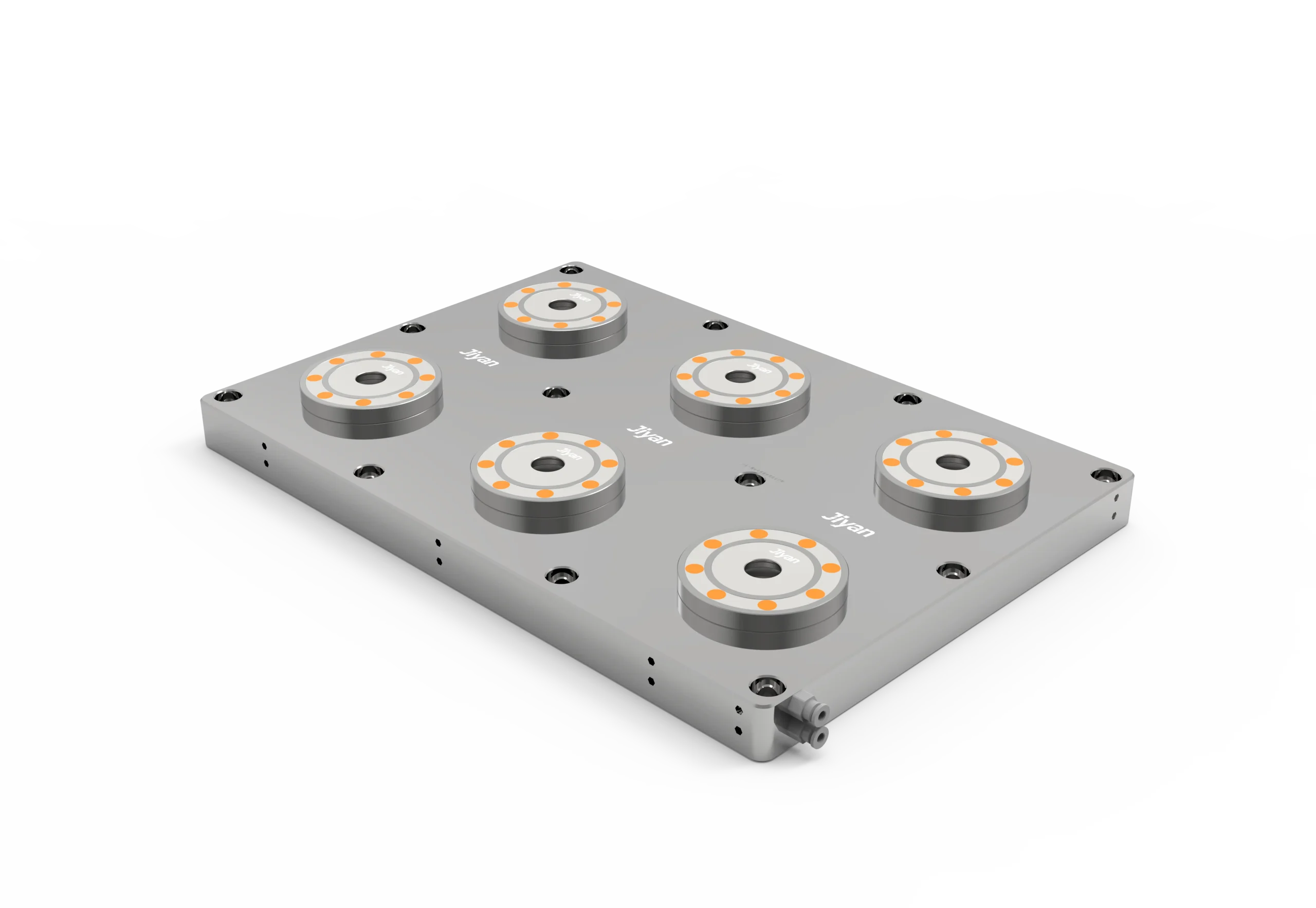
The H18-6C runs multiple stations from one air source — more parts per cycle.
A double-sided zero-point pallet lets you flip a self-centered part without re-indicating. This can be a natural next step when a shop is reducing the manual portion of CNC changeovers.
Pneumatic Vise Applications in CNC Machining
High-Volume Aluminum and Stainless Steel Machining
When the cutting conditions are compatible with the available clamp force, pneumatic vises can provide a fast and repeatable workholding method for production runs in aluminum and stainless steel.
Production CNC Workholding
For repeated parts, the main value of pneumatic workholding is process consistency. A regulated pneumatic system can repeat the clamping action without requiring the operator to manually apply force on every cycle.
Automated CNC Loading and Unloading
Pneumatic clamping can be integrated into automated loading and unloading sequences. This makes it relevant to CNC cells designed for reduced operator intervention and higher machine utilization.
How to Choose Between a Pneumatic and Hydraulic CNC Vise
Use this short test:
- Hundreds of repeat cycles, mixed materials, and a clean production cell → consider a pneumatic CNC vise, ideally self-centering when automatic positioning is valuable.
- Heavy roughing on hard steel with high cutting forces → consider a powered hydraulic CNC vise.
- Production and heavy roughing on the same floor → standardize on pneumatic workholding where it fits and keep hydraulic capacity for demanding operations.
- Automated loading and unloading → prioritize fast, repeatable pneumatic clamping and evaluate multi-station configurations.
- Uncertain workholding performance工件夹持性能不确定 → read our 数控工件夹持购买指南。CNC workholding buying guide before choosing either drive type.
Frequently Asked Questions About Pneumatic and Hydraulic Vises
Is a pneumatic CNC vise strong enough for machining steel?
It can be, depending on the vise size, air pressure, jaw design, part geometry, cutting forces, and required safety factor. Pneumatic clamping should be correctly sized for the specific machining operation rather than judged by drive type alone.
Is a pneumatic vise faster than a hydraulic vise?
Pneumatic actuation is often very fast and is well suited to repetitive production cycles. Actual cycle speed depends on the cylinder, valves, air supply, stroke, and overall system design. Properly engineered hydraulic systems can also achieve fast cycle times.
What is a pneumatic self-centering vise?
A pneumatic self-centering vise uses air-powered actuation to move opposing jaws toward a common centerline. This helps establish a repeatable part position and can reduce manual positioning variation during production loading.
When should you use a hydraulic CNC vise?
A hydraulic CNC vise is a strong choice when the application requires high clamping force, particularly during demanding roughing operations. It can also make sense when a shop already has the hydraulic infrastructure required for the cell.
Can pneumatic workholding be used with CNC automation?
Yes. Pneumatic workholding can be integrated into automated CNC loading, unloading, palletizing, and multi-station workholding systems. The clamping sequence can be controlled as part of the overall cell cycle.
Conclusion
Pneumatic vs hydraulic vise is not a contest with a single winner. For high-volume CNC, pneumatic systems can offer fast actuation, repeatable clamping, clean operation, and a practical path to automated workholding. Hydraulic systems remain valuable when heavy roughing and high clamp force are the primary requirements.
Choose the drive technology based on the majority of your actual machining conditions, then size the vise around the required force, jaw stroke, part geometry, and production cycle.
Want to size a pneumatic self-centering vise or a six-station cell for your parts? 想为您的零件选择合适的气动自定心虎钳或六工位加工单元?Contact JIYAN,我们可以帮助您匹配合适的钳口行程和工位数量。 and we can help match the jaw stroke and station count to your work.
Both drive types sit inside a wider vise landscape, mapped type-by-type in the CNC vise guide这两种驱动类型都属于更广泛的虎钳领域,在数控虎钳指南中按类型进行了映射。.