
CNC Automation Warehouse | 5-Axis Automated Loading & Unloading
Automating a machine tool is a solved problem. Automating the material that feeds it is not.
A robot cell that tends a single machine still needs someone to walk over with the next pallet. An EDM department running electrodes still needs someone to count what is left on the shelf. Those two jobs — carrying material and knowing where it is — are usually what limits a shop to attended shifts, no matter how good the robot is.
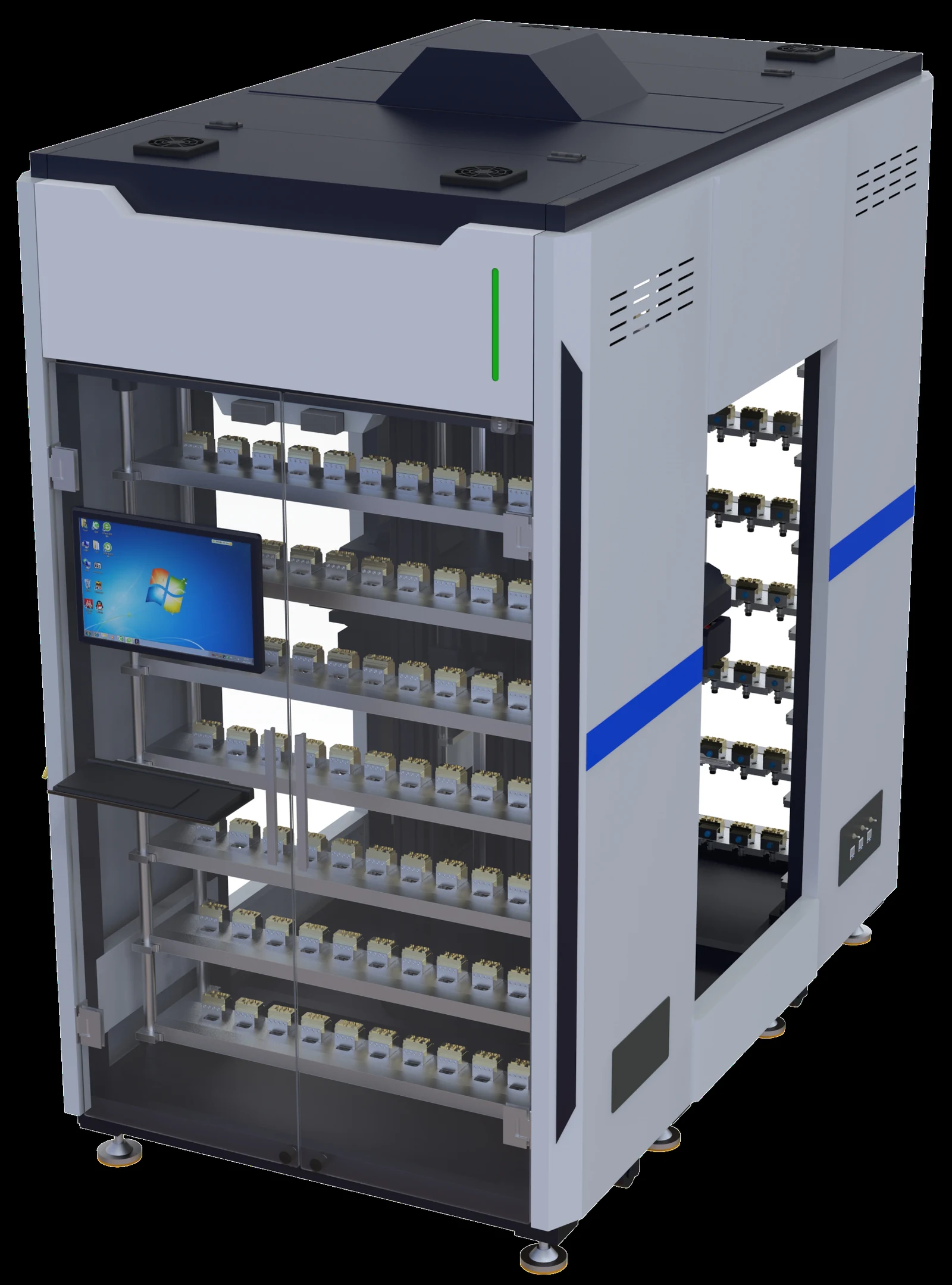
The JIYAN Intelligent Automation Warehouse exists to close that gap. It puts a two-sided material rack and a 5-axis servo manipulator in one unit with a 2100 × 1300 mm footprint, so workpieces, electrodes and pallets move between storage and equipment without an operator standing next to the door.
What Is a CNC Automation Warehouse?
A CNC automation warehouse is not a storage rack with a robot bolted to the side. It is a single system that owns both the material and the movement of that material — one unit that knows which position holds which part, and can fetch it on demand.
The distinction matters in practice. If storage and handling are two separate purchases, you get two separate interfaces, two control systems, and a gap in the middle where material gets lost. Integrating them is what makes unattended hours possible.
The system is built around four objectives taken directly from how shops actually lose time:
- Compact integration — storage and handling share one enclosure instead of occupying two bays
- Efficient production — material is fetched while the machine is still cutting, not after it stops
- Multi-machine adaptability — the same unit can serve one machine or two, and can be repositioned as the cell changes
- Automation integration — storage connects to machining, inspection and EDM equipment through one control layer
Because material transfer and pallet changeover become machine operations rather than human ones, handling variability drops out of the process. That is the part that improves yield — not the robot's accuracy, but the removal of judgement from the material flow.
How 5-Axis Automated Loading and Unloading Works
The handling end is a five-axis servo manipulator. Five independently driven axes work together so the end effector can approach a part from any direction and reach it in the orientation the gripper needs — rather than requiring the part to be presented in one fixed attitude.
| Axis | Function | Range |
|---|---|---|
| J1 | Rotation (carriage) | +140° / −185° |
| J2 | Vertical travel | 0 / +1350 mm |
| J3 | Extension travel | 0 / +1200 mm |
| J4 | Rotation (wrist) | +100° / −100° |
| J5 | Rotation (end effector) | +200° / −200° |
This is the difference between a pick-and-place gantry and a genuine manipulator. A gantry can move a part from A to B if both points are reachable in one attitude. A five-axis arm can rotate the part, present it at an angle, insert it into a fixture, and reach into the two sides of the rack — which is what makes single-variety, high-volume production practical, where the same part has to be handled hundreds of times with the same result.
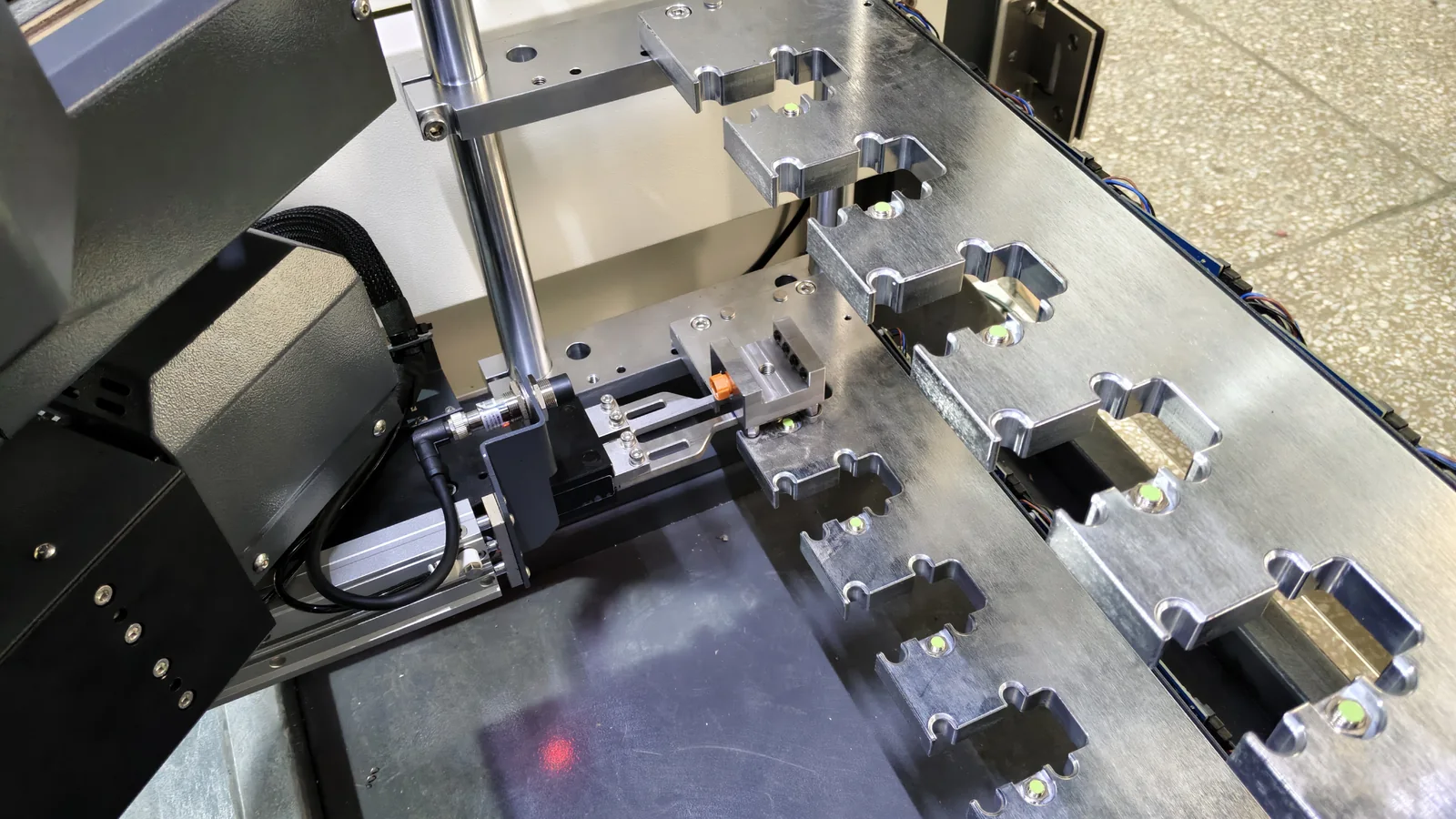
The shelf plates are machined from steel stock in one piece rather than assembled. That is a deliberate choice: a rack that deflects under a 140 kg layer load will not hold positioning, and the manipulator cannot compensate for a shelf that has moved.
The unit is also designed to sit parallel to the machine and its fixtures rather than at the end of a conveyor. Keeping the warehouse alongside the equipment is what holds the cell inside a normal factory aisle.
CNC, CMM and EDM Automation Applications
The same platform is specified for three very different material types, which is why the end effector and rack options matter as much as the arm.
CNC Machining Automation
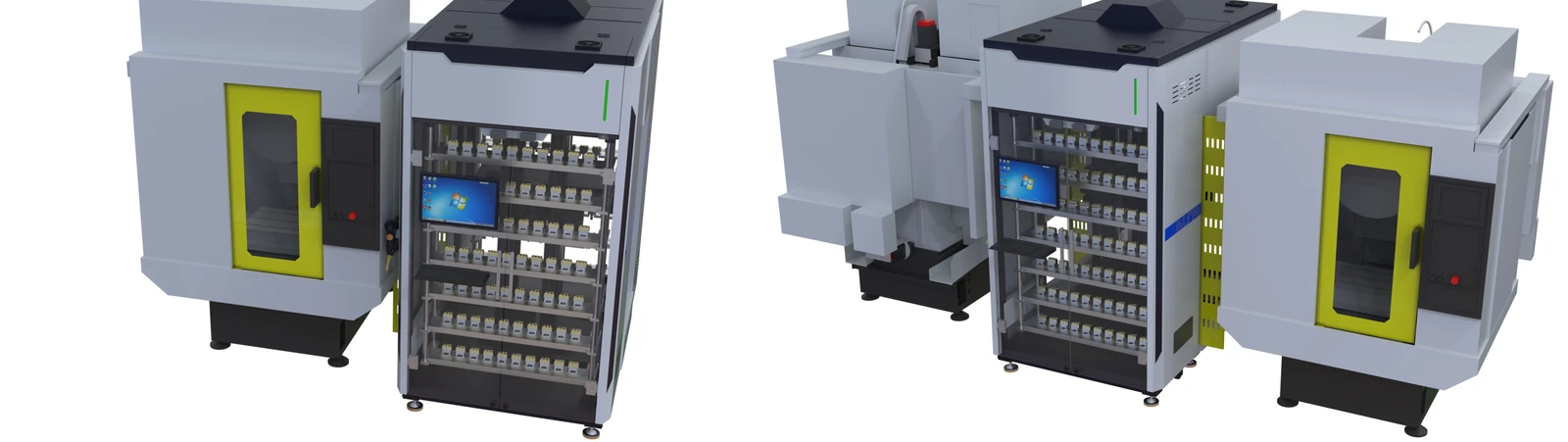
For CNC machining, the warehouse feeds workpieces to the machine and returns finished parts to storage. In a typical layout it is positioned between two machine tools, so one handling unit serves two spindles — the machine that is cutting is restocked while the other is still running.
That is the configuration where the economics change. One manipulator and one rack spread across two machines costs far less per spindle than two dedicated robot cells, and neither machine ever waits for an operator to arrive with material.
CMM Inspection Automation
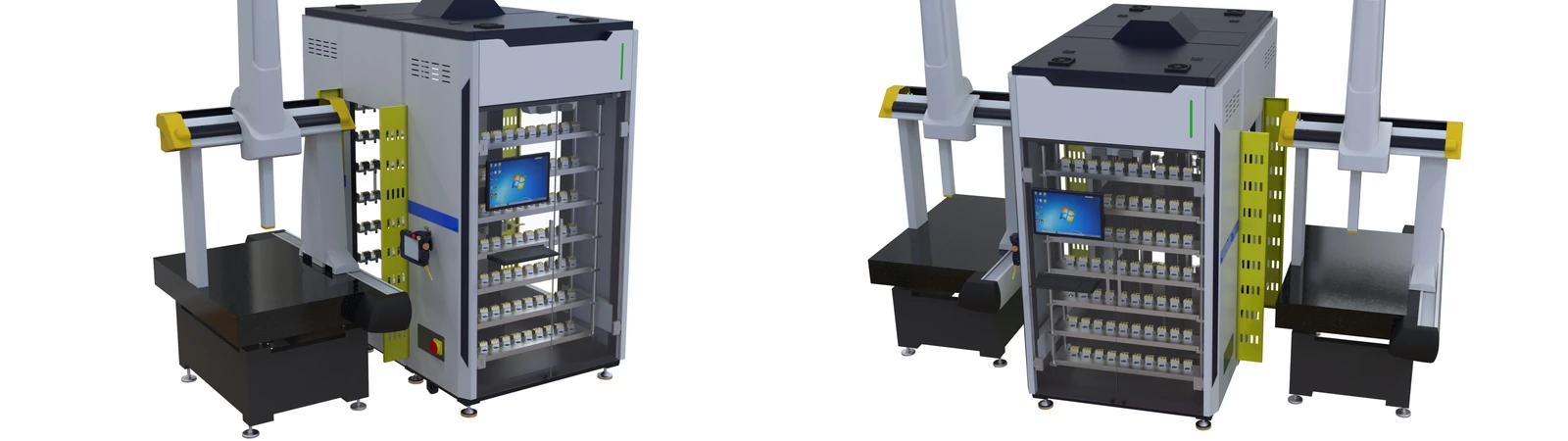
For coordinate measuring machine applications, the warehouse connects workpiece storage to the inspection machine. Parts move from machining storage to the CMM and back without a person deciding which parts to carry over.
The practical value is not inspection speed — it is that inspection becomes part of the material flow instead of a separate trip. Parts that would otherwise be inspected "when someone gets to it" get measured in sequence.
EDM Automation
EDM is where an automation warehouse earns its place fastest, because electrodes are numerous, small, and easy to lose track of. The system stores and handles electrodes on ITS50 electrode holders, keeping the electrode library inside the automation loop rather than on a trolley at the side of the machine.
Material preparation, storage and machine operation become one continuous flow — and the electrode you need is in a numbered position, not in a box somewhere.
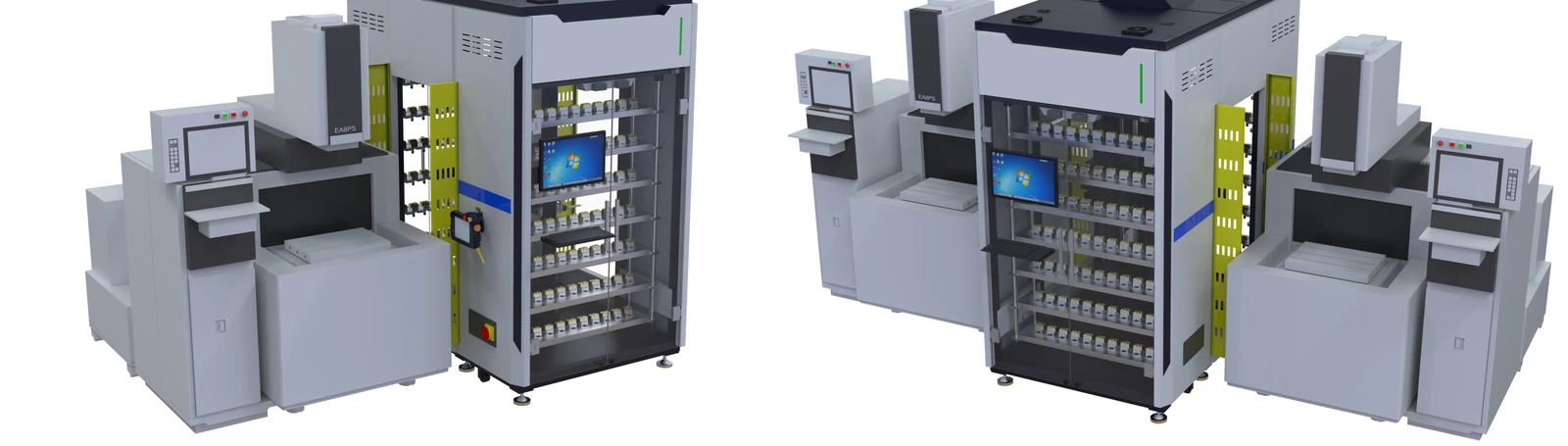
Each of the three applications is available in a one-machine or two-machine configuration, with the warehouse placed alongside the equipment rather than in a separate automation area.
Automated Material Storage for CNC Production
Storage capacity is what decides how long a cell can run without intervention, so it is worth reading the numbers carefully — the position count depends on what you are storing.
The rack holds 14 layers total, 7 per side, with a maximum of 140 kg per layer. Shelf pitch is 220 mm and shelf plates are 36 mm thick, machined steel.
| Rack configuration | Position pitch | Positions per side | Positions total |
|---|---|---|---|
| ITS50 electrode holders | 86 mm | 70 | 140 |
| ITS148 pallets | 180 mm | 35 | 70 |
Both racks share the same envelope: 1300 × 320 × 1850 mm per rack, compatible with ITS50 electrode holders or ITS148 pallets respectively.
Two loading limits are worth planning around:
- ITS50 electrode holders — maximum electrode holder + electrode height 120 mm, up to 10 holders per layer at an envelope of ≤80 × 80 mm. Parts larger than 80 × 80 mm must be spaced out, which reduces usable positions.
- ITS148 pallets — maximum pallet + workpiece height 120 mm, up to 5 pallets per layer.
Workpieces can be stored upright or inverted, and the position layout is customisable rather than fixed — so the rack can be mixed across electrode and pallet positions if the work demands it.
30 kg and 80 kg Robot Payload Options
The platform is offered in two payload ratings, and the choice is driven by the heaviest thing the gripper has to lift repeatedly — part plus end effector plus fixture.
| Intelligent Warehouse-30 | Intelligent Warehouse-80 | |
|---|---|---|
| Robot payload | 30 kg | 80 kg |
| Working radius (5th-axis centre) | 1400 mm | 1280 mm |
| Power | 3.5 kVA | 4 kVA |
| End-flange signal interface | 8-pin | 12-pin |
| Standard end effector | Single-station electrode gripper | Gripper claw + single-station electrode gripper |
| Weight | 1.8 t | 2.0 t |
The trade-off is worth understanding before specifying. The 80 kg unit carries more than twice the load but has a shorter fifth-axis working radius — 1280 mm against 1400 mm. Payload and reach are bought from the same structural budget, so a heavier gripper package means the rack has to sit marginally closer to the machine.
Both models share the same 2100 × 1300 × 2450 mm envelope, the same 140 storage positions in the ITS50 configuration, and the same ±0.05 mm repeat positioning accuracy. If your parts are small and numerous — electrodes, small prismatic workpieces — the 30 kg unit gives you the longer reach. If you are handling fixtures, tombstones or heavier billets, the 80 kg unit is the one, and it also comes with a grip claw as standard alongside the electrode gripper.
Both use servo drives on all five axes and are specified at ±0.05 mm repeat positioning accuracy, with backlash held to ≤0.05 mm on the two linear axes and ≤4 / ≤0.6 arc minutes on the rotary axes.
Compact CNC Automation Cell Integration
Floor space is usually the reason an automation project gets shelved. This system is sized specifically to avoid that.
The unit measures 2100 × 1300 × 2450 mm (L × W × H) and is designed to sit on the shop floor next to existing equipment — the machine and its fixtures are positioned parallel to the warehouse, not in a separate cell behind a fence.
Two layout details come out of the product drawings and are worth allowing for at the planning stage:
- Door swing. The rack doors open outward and require clearance on both faces. Do not size the aisle to the cabinet footprint alone.
- Two-sided access. Because both sides of the rack are loaded, the unit wants total access, not a wall position. In a two-machine layout the warehouse sits between the machines — which is exactly where the aisle already is.
End Effectors and Storage Options
The gripper is the part of an automation system that is most often wrong for the job, so the platform is offered with a range of tooling rather than one fixed head.
End effectors:
- Single-station electrode gripper — standard on both models
- Gripper claw — standard on the 80 kg model
- Dual-station electrode gripper
- D148 round gripper
- Single-station workpiece gripper
Storage and pallet options:
- Electrode-holder positions (ITS50)
- Pallet positions (ITS148)
- ITS pallet rack, up to 70 pallet positions
- Expandable third storage area
This is where the system's flexibility actually lives. The electrode flow (holder + electrode gripper) and the pallet flow (pallet + grip claw or workpiece gripper) are different material strategies, and the rack can carry both — or start as one and be extended with the third storage area later.
Control, Communication and Machine Interfaces
Automation fails at the interface more often than at the mechanics, and this system is specified with that in mind.
- Siemens S1200 PLC — standard industrial control, familiar to maintenance teams
- Modbus communication protocol
- 2 × LAN interfaces — separate networks for the cell and the plant
- Integrated material-position and part-status identification — the system knows which position holds what
- 19-inch industrial PC — J6412 CPU, 16 GB RAM, 1 TB SSD, licensed OS
- Machine docking interface — aviation plug connector for connection to surrounding equipment
- End-flange electrical signal interface — 8-pin (30 kg model) / 12-pin (80 kg model)
- Air supply — minimum 0.5 MPa, maximum consumption 100 L/min
- Power — 220 V, 50/60 Hz
The integrated material and part-status identification deserves a second look. It is the difference between a robot that moves parts and a system that can report where material is — which is the same information a scheduling system needs in order to keep a cell fed overnight.
Technical Specifications
| Specification | Intelligent Warehouse-30 | Intelligent Warehouse-80 |
|---|---|---|
| Robot payload | 30 kg | 80 kg |
| Drive | Servo motor | Servo motor |
| J1 rotation range | +140° / −185° | +140° / −185° |
| J2 travel range | 0 / +1350 mm | 0 / +1350 mm |
| J3 travel range | 0 / +1200 mm | 0 / +1200 mm |
| J4 rotation range | +100° / −100° | +100° / −100° |
| J5 rotation range | +200° / −200° | +200° / −200° |
| Working radius (5th-axis centre) | 1400 mm | 1280 mm |
| Max. J1 / J4 / J5 speed | 180° / 225° / 225° per s | 180° / 225° / 225° per s |
| Max. J2 travel speed | 285 mm/s | 285 mm/s |
| Max. J3 travel speed | 580 mm/s | 580 mm/s |
| J1 backlash | ≤4 arc min | ≤4 arc min |
| J2 / J3 backlash | ≤0.05 mm | ≤0.05 mm |
| J4 / J5 backlash | ≤0.6 arc min | ≤0.6 arc min |
| Repeat positioning accuracy | ±0.05 mm | ±0.05 mm |
| Storage positions | 140 (ITS50 holders) / 70 (ITS148 pallets) | 140 (ITS50 holders) / 70 (ITS148 pallets) |
| Storage layers | 7 per side, 14 total | 7 per side, 14 total |
| Max. shelf load | 140 kg/layer | 140 kg/layer |
| Workpiece placement | Upright / inverted | Upright / inverted |
| Standard end effector | Single-station electrode gripper | Gripper claw + single-station electrode gripper |
| Min. air pressure / max. consumption | 0.5 MPa / 100 L/min | 0.5 MPa / 100 L/min |
| Voltage / frequency | 220 V / 50–60 Hz | 220 V / 50–60 Hz |
| Power | 3.5 kVA | 4 kVA |
| PLC | Siemens S1200 | Siemens S1200 |
| Communication protocol | Modbus | Modbus |
| LAN interfaces | 2 | 2 |
| End-flange signal interface | 8-pin | 12-pin |
| Material / part status identification | Integrated control | Integrated control |
| Monitor | 19 in | 19 in |
| Industrial PC | J6412 CPU / 16 GB / 1 TB SSD | J6412 CPU / 16 GB / 1 TB SSD |
| Machine docking interface | Aviation plug connector | Aviation plug connector |
| Overall dimensions (L × W × H) | 2100 × 1300 × 2450 mm | 2100 × 1300 × 2450 mm |
| Equipment weight | 1.8 t | 2.0 t |
Specifications are taken from the manufacturer's product documentation and are provided for reference. Final configuration should be confirmed with the manufacturer.
How the Warehouse Fits Into a Workholding System
An automation warehouse solves the material problem. It does not solve the clamping problem — and the two have to be designed together.
There is no point loading parts automatically if the fixture still needs an operator to feel whether the clamp took. The interface that makes an automated cell work is the same one that makes manual changeover fast: a repeatable datum the robot can teach once.
Three pieces of the system usually go with an automation warehouse:
- A 5-axis workholding interface, so parts can be presented in the attitude the gripper picks them in and the fixture holds them for multi-face access.
- A zero-point clamping system, so pallets and fixtures locate to one repeatable datum and the robot only has to learn one pick-and-place position per part.
- Pneumatic workholding for clamping that can be triggered and confirmed by the cell rather than by hand — and that holds its state if air is lost mid-cycle.
Choosing the automation hardware is the last decision, not the first. If you are still at the stage of working out whether your fixtures are ready to be loaded by a robot, the guide on automation-ready CNC workholding covers the sequence — one datum, offline setup, verifiable clamping, then the loading mechanism.
Frequently Asked Questions
How many parts can the warehouse store?
It depends on the rack configuration. With ITS50 electrode holders the rack holds 140 positions across 14 layers (7 per side). With ITS148 pallets it holds 70 positions. Both use the same rack envelope of 1300 × 320 × 1850 mm.
Can one warehouse serve two machines?
Yes. The system is offered in one-machine and two-machine layouts for CNC, CMM and EDM, with the unit positioned parallel to the equipment so one rack and one manipulator feed two machines.
What is the difference between the 30 kg and 80 kg models?
Payload and reach. The 30 kg model carries 30 kg with a 1400 mm working radius; the 80 kg model carries 80 kg with a shorter 1280 mm radius, and adds a grip claw as standard alongside the electrode gripper. Both share the same footprint, storage capacity and ±0.05 mm repeat positioning accuracy.
Does it work with existing machines?
The system connects to surrounding equipment through an aviation plug docking interface, Modbus communication and 8- or 12-pin end-flange signals. Because the unit is positioned alongside the machine rather than integrated into it, it can be added to an existing cell.
Is it suitable for high-mix, low-volume work?
It is specified for single-variety, high-volume production — repeated handling of the same workpiece, which is where automated storage pays back fastest. High-mix work depends more on how quickly fixtures and pallets can be changed over, which is a workholding question before it is an automation question.
Conclusion
An automation warehouse is a material logistics decision: it decides whether a cell can run without someone carrying things to it.
With 140 storage positions in the ITS50 configuration, ±0.05 mm repeat positioning accuracy, two payload ratings covering 30 kg and 80 kg, a 2100 × 1300 mm footprint, and one- or two-machine layouts across CNC, CMM and EDM, the JIYAN Intelligent Automation Warehouse is a configurable way to put material handling inside the automated cell rather than beside it.
It works best as part of a planned system — the storage, the manipulator, the fixture interface and the clamping all specified together. If you are building that system, start with the question of what the robot will pick up and how the fixture will confirm it, and size the warehouse to match.
Building an automated cell or extending an existing one? See how JIYAN workholding is applied across industry applications, or request a quote with your part envelope, machine list and target unattended hours. We will tell you honestly whether an automation warehouse is the right next step — or whether the fixture interface should come first.